Don’t let culture be reason to isolate ourselves from others

This piece first appeared in The Herald on 12 January 2017

December holidays in South Africa, perhaps more than anywhere else in the world, are a glorious celebration of idleness; an annual reminder to all of us that there is so much more to this life than working for a boss.

img_5133-1
The young man returning from the bush dresses in a certain way (Photo: Tamarisk Glogauer)

But, other than idleness, December in our region is also dominated by significant “cultural” and “traditional” obsessions. In my family, we follow both Xhosa and European traditions, so December means Mgidi season and Christmas season. This year was particularly intense as my second son (recently matriculated) went to the bush to participate in the thousand year old Xhosa tradition of circumcising boys and initiating them into manhood. So, this December was not just about attending the various celebrations as a guest, but rather hosting a huge feast (called an Mgidi) in my back yard in Walmer.

Of course, once everything was done with the Mgidi, the marquee taken down, the last of the ox eaten and the last Mqomboti drunk, I quickly got into Father Christmas mode and rushed off to the mall to get the gifts, the turkey, the gammon, the crackers and all the other paraphernalia that is absolutely required to make Christmas a success. It all worked out well and so many of our friends are patting us on the back for being “multi-cultural” and for “promoting diversity”.

But I have been thinking about this a little over the holidays, as the fog of burnout begins slowly to loosen its grip on my brain. I really don’t want to make myself unpopular, but I am just no longer sure that all of this talk of “embrace your culture” and “be proud of your roots” is going to be good for us in trying to build a society and a culture that attempts to pull together in the same direction. The thing is that your family traditions (be they Diwali, Imisibenzi or Christmas) are very, very useful tools at making you feel part of “the group”. There are so many little rules in these cultural events that we all “just know”. Those of us that celebrate Christmas know that Father Christmas comes down the chimney, not through the front door; we know that gifts must be wrapped and shiny paper and must be given on 25 December. We know that the Christmas dinner must include a turkey and that it is absolutely essential that you wear one of those flimsy paper hats while you eat.

img_0849
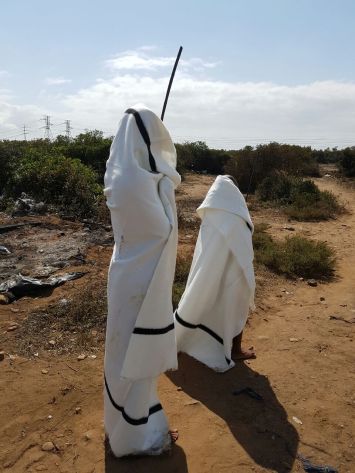
Clad in brand new white blanket the young man turns his back on his childhood and heads home – Phot0: Andrew Hewitt-Coleman

Those of us that attend Mgidis “just know” that the young man will come home from the bush in the morning to the loud bashing and clanging of pots. We know that he must be adorned in a clean white blanket and must carry a blackened stick. We know that he will be smeared in red clay by his sister and given a new name. Knowing all these rules and sub-rules makes us feel comfortable, makes us feel part of something larger than us.

But the truth is that cultural events like Christmas, Bar Mitzvahs or Mgidis originated at a time when everyone around us in any direction for a thousand kilometres spoke the same language and held the same beliefs. Cultural events were therefore a comforting and regular reminder that we are all on the same page. The reality of course is that we don’t live in that world any more. So, my fear is that the very same cultural events that evolved all over the world to make communities stronger are now having the opposite effect in an age of multiple overlapping Diasporas. What we call “culture” has the very real effect of making someone who does not know all the little rules feel like an outsider and in a very real way, unwelcome.

I may have lived next door to Greek neighbours for ten years but would still feel like I don’t belong at a birthday party where there is bearded guy dancing in circles while his mates chuck the crockery on the floor.

Otherwise intelligent friends of mine speak about South Africa being a cultural “melting pot”, where the (completely unscientific) belief is that if each family just keeps on following the same routines that our great-great grandparents did, that we will somehow magically develop a new culture and tradition that is uniquely South African. I’m sorry, but I just don’t see it. What I see from where I am standing is arrogant conservative backlash that says “this is how we have always done things and to hell with all of you!” I know that Trump supporters and Brexit people may tell you otherwise, but this mind-set can only be a recipe for extinction.

img_0853
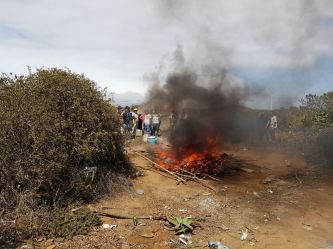
The temporary structure the boy stayed in is burned to the ground along with all boyhood possessions – Photo – Andrew Hewitt-Coleman

So what can we do?  My suggestion is that we begin to discuss the challenge of culture, but not from the perspective of trying to conserve some dying detail, but rather from the perspective of “What aspect of my family’s tradition can I soften, explain or modify to make accessible to everyone? What can I do make it easier for those around me to understand and participate in?”

And another thing: Get over yourself!  It’s just not that serious! These traditions are just a game that we play. Because deep down, in our quiet time, each of us know that we are so much more than the language we speak or the village we come from.

Let’s lighten it up a little!

My Mission and Purpose

I’ve heard a lot of people talk about “Mission” and about “Purpose”. Many go into loads of detail about what the difference is between the two. As if though they actually know. As if these aren’t just using words that point to a truth. As if these words are truths in themselves.

What I know, in my own life, is that there are certain activities, projects and tasks that inspire me to get off the couch and get things done.Does this mean that these activities are part of what I was “meant” to do. And anyway,  what could “meant to” even mean?

What I can tell you is that I am very sad about the fact that so much of my life has been spent doing things that I have for some reason or the other just felt that I “had to” do.

  • I “had to” go to school.
  • I “had to” go to the army.
  • I “had to” finish varsity.

Even in my married life I have done the things the I “had to” do. The business that I have built, for the most part has absorbed my time and energy (my life in fact) to do the things that I “had to” do in order to ensure that the business does not fail. For so much of my life I have done what I have done because I have feared the consequences of not doing them. This may be true of your life too. You may be reading this and saying “Well that’s just the way things are, how cant hey be any different?”

Perhaps though, the way for me to find my way out of this trap is for me to reflect back on my life. Because I know that there have been times where I have felt that I have been energised and driven not by fear by by something else. There have been times where I have been overcome by a strange passion. A energy perhaps that would motivate me to wake early in the morning or push until late at night. Where creativity would continue to sprout forth. Where I just felt that there was no stopping until I had achieved the immediate task or the project that had come to occupy my mind.

  • I feel this sometimes when I write.
  • I feel this sometimes when I build
  • I felt this when Pebblespring farm came to me
  • I felt this when I have fallen in love.

I know what I feel. I cant lie to myself at a deep level inside. I know that I want to make a difference. I know that I want to change the way things are. I want to change the reality of how things are for me and for so many people, who are caught in desperate and frustrating lives where they are living in fear. Where they are doing things every day, every week, every month only because they fear the consequences of not doing them. I feel energised when I imagine myself playing some small role in building freedom for myself and for these people who are trapped like me. No, I am not trapped in poverty nor in ignorance. I am not trapped by disease or physical ailment. I am not a slave to a cruel religious sect. In fact I am relatively free.

Perhaps this relative freedom helps me see how paths and routes to freedom can be built for those who are ready to free themselves. I don’t know. But I do know that I am drawn to do this work, I am tempted to say that Building Freedom is my purpose. I am tempted to say that my immediate mission is to do what ever I can to share tricks and tips that will help you and others reading this to build freedom in your own lives. But I have decided not to use the words “Mission” or “Purpose”. Rather I will say that I am following my heart. I am doing what I love to do and if you reading these pages are able to grow or become more free from what I have to say and to share, then that’s also great.

THC 12 November 2016

#Feesmustfall, brass bells and the pain of the taxpayer

 (This piece first appeared in The Herald on 19 October 2016)
A few days back, I made a short presentation on some of my recent work to a, polite audience at the newly renovated Tramways building. To be honest though, the small group of architects, historians and academics had mainly come out to hear from my colleague, Professor Albrecht Herholdt, with whom I shared the stage that evening. You see,  Professor Herholdt, is one of our region’s finest architects and he spoke that evening on the fantastic work that he and his team is doing with the MBDA to bring the historic 1820 Settler Campanile  back to life as a working tourist curiosity. The work being done there is really impressive. The bells are going to chime once again, the crumbling brickwork will be repaired and the old clock will once again be a reliable resource for those passers-by who do not wear a watch.

I was pondering this lovely presentation as I dreamily cast my eyes from the third floor window of my Clyde Street office the next morning. From my desk, I have an unsurpassed view of Algoa Bay. On a clear day I can see all the way to the Port of Nqura.  But it was not a clear day. It was not even a quiet day. In fact, I was startled out of my dreaminess by the sound of chanting and toyi-toying coming past my building. A noisy protest was making its way from Cape Road to Town. Hundreds of angry students in #Feesmustfall regalia, escorted by a massive police contingent, including a huge big water cannon truck, which had just been decorated in dripping turquoise by a protestor’s “paint bomb”. The students passed without incident. The chatter in the office was all about “Well the ANC promised free education…” and “Why don’t they just stop burning down the Libraries?”.
But I’ve been thinking about these protests a little. And the more I think of it, the more I see that these students are raising an important question that we have not yet fully debated as a country. If I am able for a moment to look past the arson, the intimidation and the thuggery, I can just see the beginnings of a meaningful inquiry into what we as a community feel is reasonable or unreasonable to expect our tax payers to pay for. I ponder this question now as I sit writing this piece in the Wimpy Bar in Port Alfred. I have stopped to rest a little from my drive back from a project meeting, coordinating the spending of hundreds of millions of tax payers Rands in new buildings to accommodate various government departments’ administration and management needs.  The driving was tough as I navigated the “stop and gos” caused by the hundreds of millions of Rands invested in widening and generally improving the coastal road from East London the Port Elizabeth.
The thing is, I have been in business for the last twenty years or so. I have paid a lot of tax in that time. I have paid Vat, PAYE, Transfer Duty, Import Duty, Capital Gains Tax, Municipal Rates, RSC levies and those taxes you pay on alcohol and fuel that I can remember the names of. Though I feel good about the fact that, through my taxes, I have been able to make some contribution to the effort to improve our country, I am also deeply conscious that every time I fork out tax money, I am not doing so voluntarily. You and I are compelled to pay tax by force and by the full might of the state. If I don’t pay, I will be jailed. If resist my captors, I will be shot. It is not overly dramatic for me to say therefor, that you and I pay our taxes at the threat of death.  It’s just a fact.

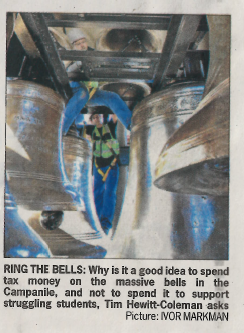
Today though, I am not making an argument for or against taxation. I am rather arguing that this money, which has been extorted from us, must be treated with a far greater measure of respect. If we are to accept taxation as a necessary evil, there must be some understanding that tax money can only be used to deliver something that the private sector would not otherwise be able to deliver.  So, I would like us all to begin to ask of each other: Why is it not a good idea to spend tax payers money to support struggling students? Why is it a good idea to spend taxpayers’ money to make it easier for lorries to drive from PE to East London, or for container ships to dock at Nqura or for for SAA so compete with Kalula.com? Can the huge industries and corporations that run these transport and logistics operations not pay for this? Why is it a good idea to spend tax money on massive brass bells in the 1820 Settlers Campanile? Can the lovers of bell chime music not pay for this? I am asking the question not because I claim to know the answer, but because I believe we have allowed ourselves to be side tracked by fear mongers and haters. We have been side-tracked to such an extent that we have not been able to hear the valid questions the students are clumsily asking…”What projects, should we as a community, invest taxpayers money in?”  “What investments will ensure the best of possible futures for our people?” “What investments can wait a little longer until we have helped each other emerge from the scourge of poverty and desperation?”

Freedom: Yes its something you build!

I love building! The hammer and nails, the step ladder, with cordless drill. The pain in my joints in the evening as I rest after a day of sweat and pain. Building of course starts way before any hammer is swung or any brick is laid. Building begins like all other created phenomena. In the mind as an idea, a notion. It may then find form words in discussion with a loved one, and argument with a banker, then later it may take the form of text, a letter, a blog post, an idea in a journal, emerging only letter perhaps into sketch form growing over self confident .  a serviette in a late night restaurant at first, a koki pen drawing on a desk pad alter, each step of this building process on closer to completing the vision and giving physical for to what was just a notion. The bricks mortar, timber an steel follow when the idea is strong enough, to survive in the physical world. I love the feeling of freedom that building gives me. The freedom to move beyond all the “reasons” why something cant be built. Overcoming them and physically seeing the from emerge to completion.


While building is my great interest and passion, so too over the years I have come to be very interested in “Freedom”. I have become interested in what this word actually means to to me, and how the idea of Freedom may be different to you reading this post right now. Also I have become especially interested in the idea….In the truth that Freedom is not something that we simply stumble across, but rather that it is something that we build for ourselves. Something that must start out as an idea, then find its way into conversation, eventually into text and writing, then documented plans and ultimately in the concrete action in the physical and spatial world.

This website is about building freedom. Not about marching for freedom or fighting for freedom or voting for freedom. Here we test the notion that for freedom to be lasting and meaningful it must find its expression first at the level of the individual. You and I. Sure we can collaborate, pool our individual energies where we can align ourselves to obtain such freedom, but here we will explore there idea that you and I must first define for ourselves what it means to be free in our own lives. Having defined that freedom for ourselves we can choose to become free or to remain imprisoned. And imprisonment may come in different forms for different people. You may be imprisoned in your job, in your sexuality, in your family traditions,in your relationship. Most people reading this will not be physically imprisoned or enslaved, but sometimes those that are physically held captive are in a way more fortunate in that there is know doubt in their mind that they are not free. they have no doubt in their mind that they are being held against their will. If they try to escape their captors, they will be instantly met with violence. In 1986 and 87 I was held captive as a conscript in the South African Defense Force. The army at the time was a brutal institution known for it cruelty and intolerance. Never once did I try to cut my way through the fences, or risk being shot by the guards. The threat of violence was though imminently clear and evident. The public punishment of those that did try to escape was enough to discourage me and most others not to even try. In that system I knew that I was not free. It was made clear by the fences, the guard towers the barbed wire and the armed guards. It was made clear by the armed military police. It was made clear by the suffering of those held in the notorious “detention barracks”.


But what about you and me today? In our ordinary jobs, in our ordinary families in our ordinary relationships. Are we free? What does it really mean to be free? I have thought about this quite a bit. I have played with a few different definitions and I suppose what I have settled for is “freedom is choosing without fear”. So, In other words if I decide to stay inside the military base because I love the accommodation the food and the camaraderie then i am free. But if i stay because I fear getting shot by the Military Police or being held in the detention barracks, then I am not free. If I stay in my job because I fear that my children will not eat, then I am not free. But you may say “well of course we need to feed our children”. Bur hear me,  To be clear I am not saying for a minute that anybody “deserves” freedom. All I am saying is that many of us. maybe most of us are not free, because we are motivated everyday by fear to get out of bed and endure what we endure.


I have come to see in my life that it must be my mission to live free. Perhaps I will never achieve this objective. Perhaps until the day I die I will be striving toward achieving a life motivated by joy and not by fear. But what I have decided is that I will not resign myself to a life of fear. I have decided to build freedom. I have decided work in the same way we would set about building a house or a church or a hospital. I have decided to build freedom in a methodical way. Starting first by recognizing where i am not freed, then conceptualizing and designing a new, free place and new reality. then working hard to build it. To make it real.


Statism and the East Cape Taxi Protest

(this piece first appeared in The Herald on 15 June 2016, under the “Title SA freedom being circumscribed)


My 1997 Toyota is currently propped up on bricks in my backyard. You see, I’m waiting for my small time mechanic “guy” to find a specific part that is being reconditioned by his small time parts supply “guy”.  I have though still managed to get around town regardless of this challenge and regardless of this week’s province wide taxi protest. This, partly thanks to Uber and partly thanks to the luck that I do not rank in the number of the struggling poor compelled to live in the far flung periphery of our sprawling metro. So, as I have zipped around town as a passenger in the last few days I have had a little more time to follow what my “friends” are saying on Facebook. Much of my feed is clogged up with pictures of cats sleeping in laundry baskets or heart wrenching messages about how not sharing this picture of a goat means that I don’t care about people dying of cancer. There was, though, some interesting talk about what people think of the taxi protest. Most of the talk was about the fear of the protest getting violent or how unfair it was that students could not get to class to write their exams.  Yes, I feel for the students. I feel for the mall bound housewives’ stuck in traffic jams. But, to be honest, I’m more interested in what this protest is really about; and as far as I can understand, it’s really is about the delay in the provincial government’s issuing of “operating licenses”. Because, you see, the state has decided that it is criminal for a hardworking person to make an honest living transporting people from A to B without their permission. Really!? Perhaps there is something that I am not getting here? But my real worry is that so many of us are completely content with the idea that the state somehow has the right to tell us what we can and cannot do and that we need their “permission” to do an honest day’s work. This state bullying is not just in the transport sector, it’s all over the economy!
 I work as an Architect. In this industry the state has decided that they do not trust the judgment of those who chose to do business with me. I am therefor required to remain “licensed” by the state. For an Architect to work without a license is a criminal offence. I go to jail! I mean, can we not be trusted as ordinary citizens to choose for ourselves who to employ to give us a lift to work or to draw up plans for the extensions to our patio?  Do we really need armies of faceless civil servants employed with our tax money in Pretoria or Bhisho to help us with this level of decision making? Perhaps the reason we tolerate this intrusion is because we have not paused to think about it?
 In the late eighties many of my friends, like me, were caught up with the idea of “freedom” and of “power to the people”. It seems though that as time has passed that ideal has evolved rather to us being content with changing the complexion of the state rather that questioning whether it was ever necessary for the state to take away our individual freedoms in the first place. The Apartheid state was unapologetic in taking away freedoms in the pursuit of “Law and Order”. At that time, citizens felt it was absolutely OK that there would be laws stopping us from selling flowers on pavements, brewing Umqomboti  in the backyard or playing guitar for loose coins at the bus stop. It was just understood that the state was in control and it was the job of each and every citizen to “stay out of trouble”. But somehow we have allowed that apartheid mindset to move with us 20 years and beyond into the “free” South Africa. The obsession with “statism” seems to be held equally by political parties to the left and the right.  The political debate is generally only about what category of additional state control can be forced upon its citizens.
Since apartheid times, the excuse used for state bullying has moved from “Law and Order” and “Suppression of Communism” to our new regime’s talk of “Health and Safety” and “Transformation”. We need though to wake up the very real possibility that our freedoms are being taken away for no reason other than to allow huge monopolies to step in and take control of the country. Putting in place “licensing procedures” on top of layers and layers of compliance requirements makes it more and more difficult for any but larger and larger institutions and corporations to keep up. State capture is not a single event, not just the Guptas, not just one corrupt politician. It is a tendency that has come with us since before we agreed in 1994 that freedom is what each and every citizen deserves and is entitled to.


So I urge each and every one of us, from today on,  to free our minds and to become openly and vocally disgusted whenever we encounter the smallest attempt on the part of the state to tell us that we are not free.  As long as we are not harming anyone, it should not be any of their damn business!

Beyond Tolerance

(This piece first appeared in The Herald on 24 December 2015)
I don’t really give too much thought to the war in Syria. There’s just too much else to think about all the time. I mean right now I am facing a real dilemma: do I buy the silver baubles  for the Christmas tree or do I get those shiny red ones with a picture of a snow man on them? …..And what about the Christmas lights? Do I get the white flickering ones my wife wants to match the candles she bought for the table or do I get the brightly coloured blinky lights that remind me of my child hood?

As children we’re taught  to tolerate nonsense  for the “sake of peace”

What I can say about the war in Syria though is that Isis has given intolerance a bad name. Realistically, Isis are just the last in a series of zealots, warlords and dictators that have left most thinking people rejecting any and all tendencies toward intolerance. The Spanish Inquisition, Robben Island and Stalin’s Gulags are all recorded testimony of murderous path down which unchecked intolerance leads. Nixon could not tolerate the idea of the Vietnamese choosing to live under communism so he bombed Hanoi back into the dark ages. Bush could not tolerate Saddam, so he bombed Bagdad.
So I completely understand how it is that the mindful and well-mannered people spend much of their time advocating “tolerance”. For much of my life too, I have argued for “tolerance”, but I have now begun to re-think
You see, in a very real way “tolerance” means putting up with what I know is wrong “for the sake of peace”. But I have come to see that this is really a very short term solution. In fact, what I am calling for now, on this Christmas Eve, is a healthy dollop of “Intolerance”. Let me explain. I am making this call to all good people, all patriots and all lovers of this beautiful ecosystem of which we are an indivisible part.  I encourage you all to take inspiration from the students who this year said: “We will not tolerate Universities being for rich people only” or from the banks and unions who forced our president to backtrack when they said: ”We will not tolerate you destroying our economy”. I encourage you to become intolerant in your home, in the street in which you live, in your shopping centre parking lot.  Because it is the poor and defenceless that carry most of the cost when our society tolerates lawlessness. It is the poor and defenceless that cannot afford short term insurance, it is the poor and defenceless who must tolerate starvation because their chickens are stolen from their back yard. It is the poor and defenceless who can’t get the time off their dead-end jobs to tolerate being sent from pillar to post by brutally mindless corporations and institutions.
So, where you witness drunkenness, littering, late coming, rudeness, cold cappuccino or institutional nonsense; don’t tolerate it. Make a scene. Find the courage to speak out. If each of us does this every day, we will be victorious.  Mayor Giuliani proved in New York, that by becoming intolerant of little “crimes” we create environment where the bigger, more serious crimes begin to dwindle. We can’t expect our overstretched Police to deal with the small stuff. There is just too much really serious crime going on. So it’s up to you and I to become intolerant today.

Go now and rest; but rest with one eye open for that drunk uncle that may be thinking of stepping out of line. And when you put him in his place and correct his behaviour know that it is no less than your patriotic duty to have done so.

Help Little guy with Direct Action

(This piece first appeared in the Weekend Post on 31 October 2015)
I drive a 1997 Toyota. It has 476 000 kilometres on the clock. I drive this old car mainly to embarrass my children, but also because I know that renewing my car every two or three years has a hugely destructive impact on our planet. In fact, a recent report in the Guardian  points out that the amount of carbon that it takes to make a car (its “embodied emissions”) is very likely to be greater that the total exhaust pipe emissions over its lifetime. What the Guardian is trying to say is that my clapped out old rust bucket is better for the planet than a brand new super-efficient, high tech Hybrid!
My 1997 Toyota, when it was still young

I take the health of our planet very seriously. You and I know however that the truth about our country, and many others like it, is that the most pressing threat is not the levels of carbon in the atmosphere, not the depletion of the ozone layer, not even the desperate and sad story of the Rhino. No, the most pressing threat to our society is poverty and exploitation. Poverty is a breeding ground for disease, ignorance, corruption and crime. Quite simply, we are all doomed if we are not able to build a stable economy where each and every one of us feels that it is worthwhile to make our best effort every day to improve the health and welfare of ourselves and of our families. What I want to talk about today though, is what it is we do about this situation. You see, I am inspired and impressed by the direct action students across the country have taken in dealing with tuition fees. Inspired; because students are showing us that it is far more effective to take direct action than it is to put our trust in party politics. The students of 2015 have shown us, that if we want to get something done, we must get off our backsides and take direct action. The students of 2015 focussed on the issue. They set aside party politics; they set aside complexion and economic status. They focused on one issue and they were very effective.

But, “Direct Action” is not only about blocking traffic and singing songs. “Direct Action” is about our choices. It’s about what I produce and about what I consume. It’s about how I choose to act. So, it was no less that an act of revolutionary defiance that I had my car repaired on my front lawn this Saturday while my neighbours were indoors watching the rugby. (Yes, the old crock breaks down from time to time!) You see, I could have opted to have the work done by the recommended, massive Japanese owned multinational corporation, but instead I opted for “Direct Action” and chose to employ a trusted, loyal and brilliant small time mechanic to repair the broken starter motor. It cost me a lot less. He earned very good money. It’s a “win-win” situation. No massive corporation, no CEO salary, no marketing budget and TV ads, just a small time “guy” with his box of tools on my lawn. I do the same when I need bicycle repairs, carpenter, plumber, electrician, tailor or plumber. It’s the right thing to do.
You may be surprised to hear of the good work that the Metro is doing to support small business.  In fact, all municipal construction projects now require that 25% of the work is done by Small Medium and Micro Enterprises. Believe me, this is really painful to people like me, who are called upon from time to time to design and manage these projects. There is a heap of complicated paperwork involved and it really is a lot easier to get the work done where your contractor is listed on the JSE. The point is though, that the Metro is being responsible and is leading the way in this action. My appeal is that each of us follows this lead. That each of us, in our businesses and families make a commitment to allocate a portion of our annual spend to emerging businesses. (Perhaps 10% may be easier to achieve initially.) But even at those levels, by direct action, we will be able to make a massive and lasting dent on poverty.
What I am proposing is that each of us builds “bridges” between those of us who have emerged from poverty and those of us that are making the effort to do so. It really is a two way street. If you are working to emerge from poverty, make it easy for those that want to trade with you. Answer your phone. Arrive on time. Do what you promise. For those of you that are trading with those emerging from poverty; yes, it does take more effort. You will need to search a little harder to find the service you are looking for. You will need to check the references. You will need to pay promptly. But that is the Direct Action that we can take. Consumers may complain that there are not enough emerging businesses to address the most pressing needs, but we must trust that these will emerge if there is good money on offer. Emerging businesses may complain that there are not enough customers, but we must trust that these will emerge when we have good product to offer.
Political parties cannot do it for us. The future is in our hands and direct action is the tool we will use to build that future. Start today!

Tao of the farm – Principle number 17: “Don’t sell the farm to buy a tractor”

One of my favourite “tools” on the farm is our little 160cc Suzuki quad bike. My friend Eldred had it lying around in his garage and gave it to us as a gift when we first bought the farm. What I like about it is that it’s small and light, but powerful enough to take a load of fence poles or drag a log out of the dam.

Having a big fancy John Deer tractor would be great, but very expensive, so right now we make do with what we have. The heavier puling tasks the quad bike can’t handle, I use my 4X4 for. The big digging and pushing tasks I hire in a TLB at R300.00 per hour. No, it’s not ideal, but I am working within the realistic limitations of what we have and how best we should invest what we have. And what’s more, the quad bike is agile, it has a tight turning circle, it can manoeuvre through narrow paths in the forest. Places where a tractor just could not get right now. The quad bike is also light on the ground, it will not easily compact the soil or sink into muddy patches. Oh yes, and of course, it doubles as a toy. I feel quite comfortable to let even smallish children take turns up and down the driveway on the quad bike. I would not be able to let them do this with a tractor.

My policy favouring a quad bike (for now) over a tractor I suppose comes out of a long tradition where my grandfathers’ grandfather would have had to make such conscious choices all the time. My grandfather’s grandfather would have lived on a farm; he would have known that if he invested too heavily in extravagances he would struggle to feed his family. If that meant walking to town because he could not yet quite afford a horse cart, then I guess that is what he would have done. If that meant housing is family in a one roomed cottage, that is what he would have had to do. That’s just the way things were, and actually that’s still the way things are.
Except…
Our modern urban lives have helped to blur the lines between what is possible and what is impossible. Banks and other credit giving business have created the illusion that we can have anything we want right now. All we have to do is sell our future lives to them. All we have to do is to agree to labour for them. So we buy the horse cart, or the three roomed cottage or the tractor, but we sell the very thing we were trying to attain by entering into the bargain. Let me be clear. In some way or other, we are always trying to be free. When we buy something or build something it is in order that we may be free. Free from discomfort, free from toil and struggle, free from inconvenience. We are always trying to buy our freedom. The banks and credit giving institutions know this, but also know that we have become conditioned to selling our very freedom, our future time and energy for the privilege of having right now what we actually can’t afford to have right now.
The debt trap has become so common and so widespread that it has become generally accepted that this is the route any young person should follow when leaving home and embarking on their journey to independence. Young people who do not go into debt to buy cars, clothing and big screen televisions risk becoming social outcasts. There are the brave ones that do resit the trend, but these are a very small, very courageous minority of thought leaders.
I must be careful to clarify that I am not speaking out against debt as a concept; I am speaking here about moving toward some acceptance that debt is a very powerful and at the same time a very dangerous tool. Clever people have learned how use debt to invest well and build empires that serve them and their families for generations. But debt is dangerous. Like dynamite. Not something to hand out an street corners to children , but something to entrust to experienced miners who after years of training, know how to apply its force surgically and precisely to extract the ore from the rock. Right now, we are suffering a pandemic of indebted , young and old, running around dazed through the city streets with sticks of dynamite blowing off hands and limbs.


I am not saying that buying a tractor is a bad idea; I am not saying that debt is a bad idea; I am saying that we must be become skilled before making decisions so that we are not tricked into selling the farm to buy the tractor.