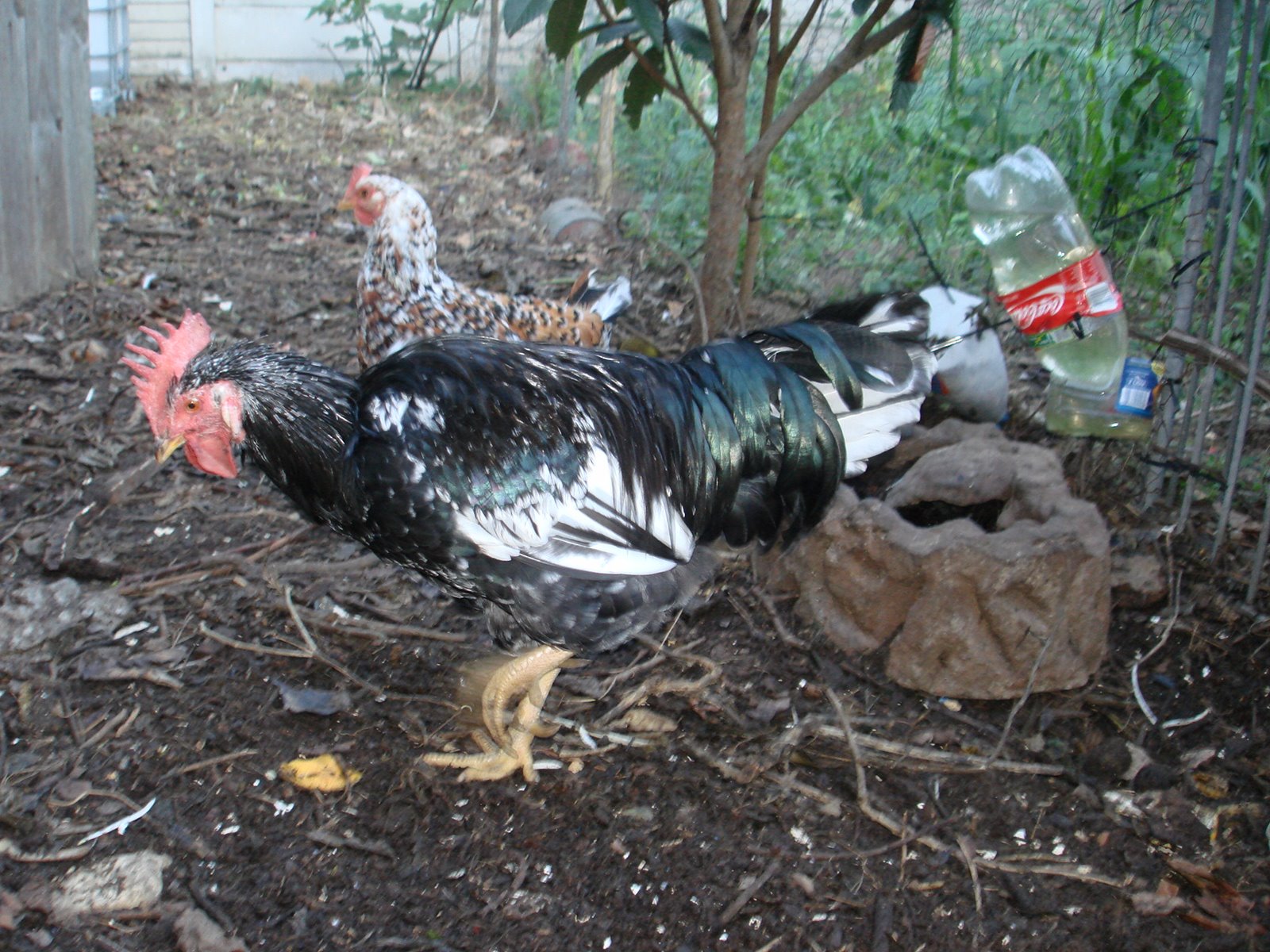
Though the hen was sitting on eight eggs. only three hatched. I have made a cage for the hen and chicks to be kept in. This should keep them safe from the other chickens and from rats.
The Wildside
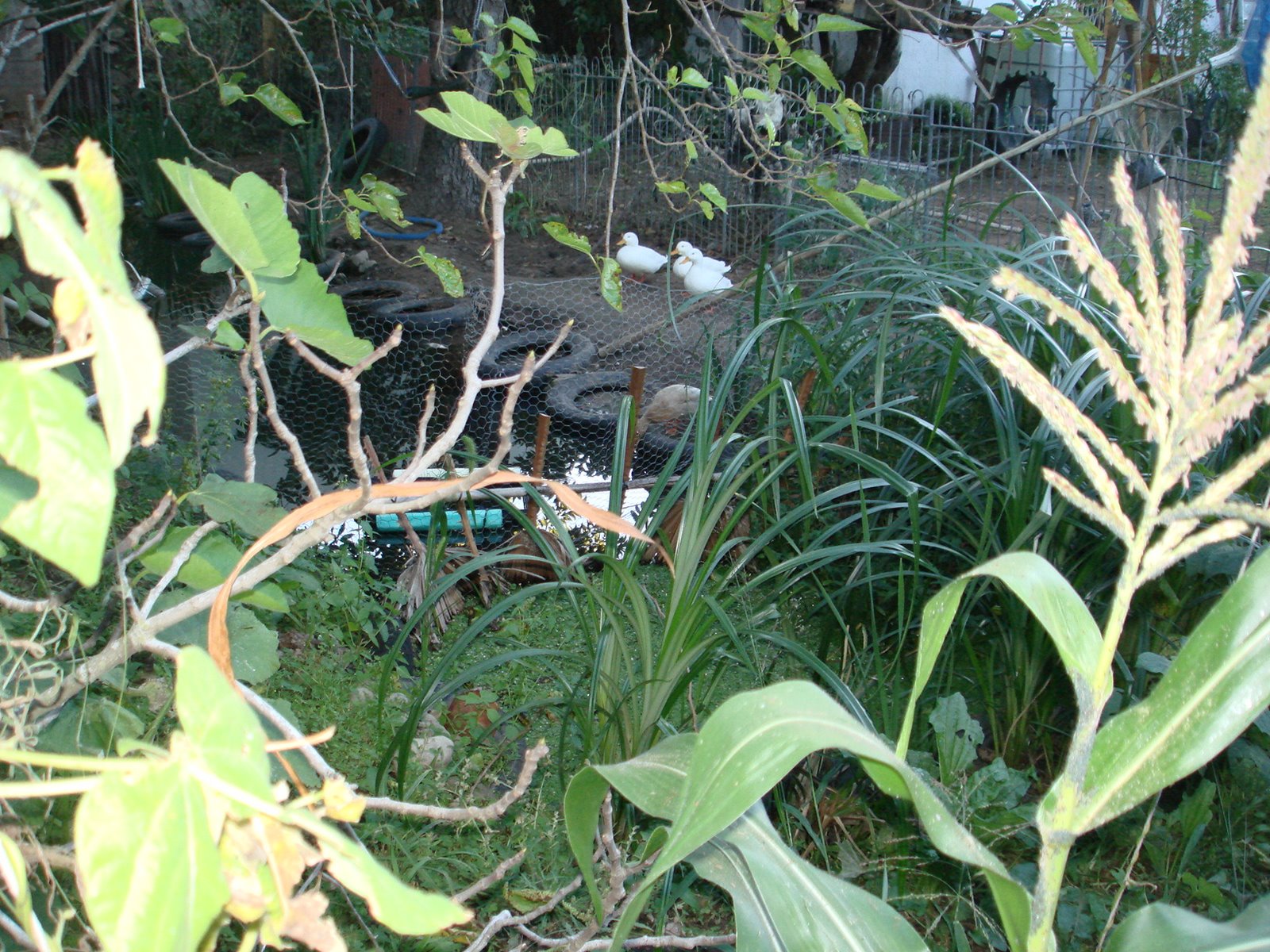
The ducks eat anything green, So what I have done is to put up a little fence separating the east end of the pond near the chicken run, from the rest of the pond. The fence runs through the water. I have planed waterplants and veggies on the protected side. In the water I am growing duck weed, which the Tilapia can eat from underneath.
Venda Fowl in Hay Yard
Duckpond at 92 Pospect
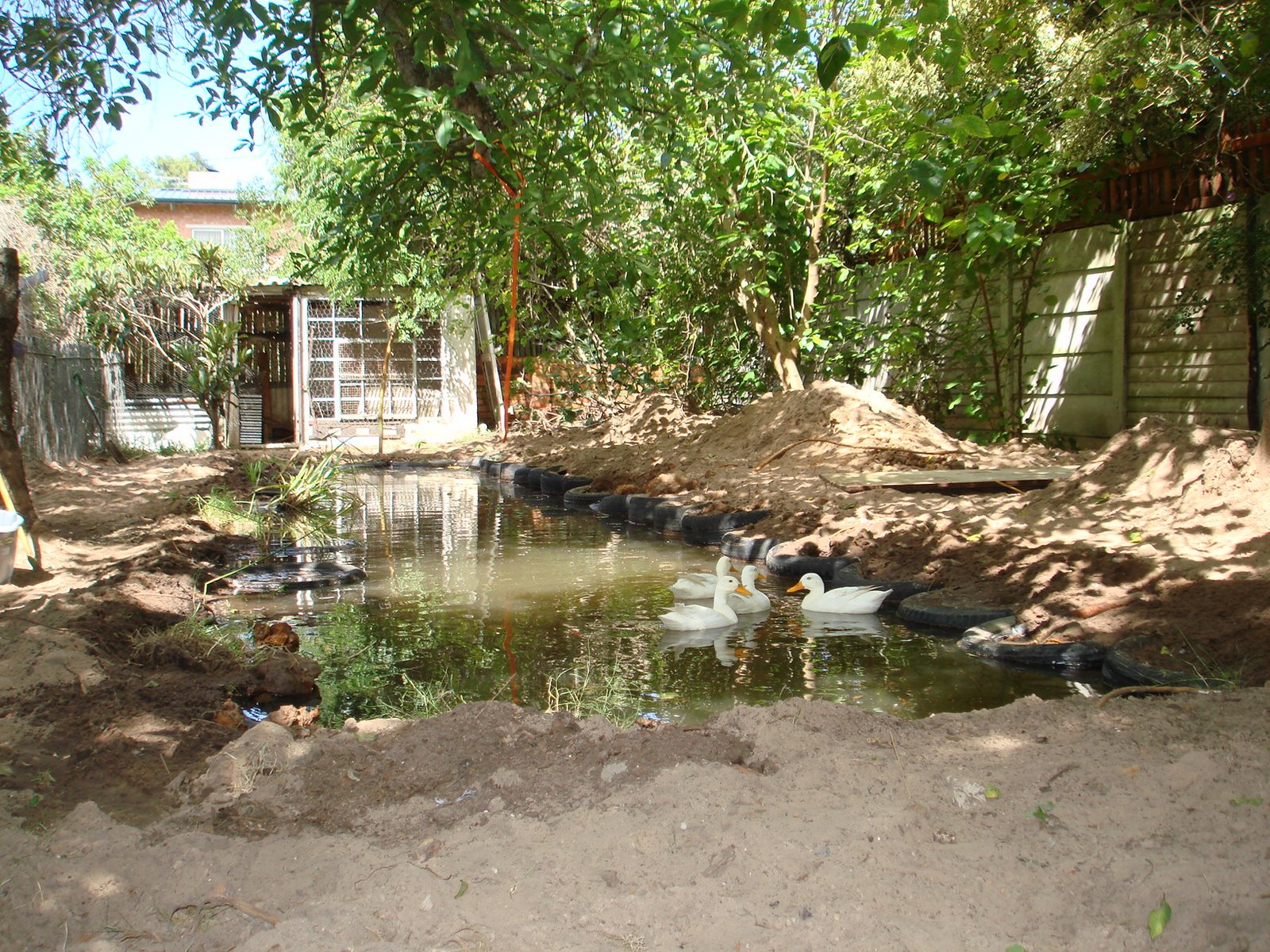
Edit 11 May 2014 – What we found is that the ducks completely demolished the duckweed and another vegetation very quickly. The water, even from these few ducks became very dirty, too dirty to keep Tilapia in any reasonable way.
Appeal to Israeli Conscripts
Israeli Conscripts. You have a choice. I explain what I mean in this
White Quackers on New Pond
I have decided to farm. I am not waiting for retirement. I am not waiting to buy farm land some time in the distant future. I am starting now.
(edit – 11 May 2014 – The duckpond we built is at our residence in Walmer – its a 1500 sq m plot and it still houses the duck pond, though there are no ducks on it and it is now quite overgrown with some Tilapia under the surface and some duckweed floating on top)
The Public Market at Inhambane – Mozambique
Soweto Sprawl
Troops in the Townships … (again)
Troops are back in the townships again. The poor and oppressed will turn on each other now as much as they did in the eighites. They are in pain and want to turn that pain into anger. In the eighties that anger was directed at the system and sellouts and now the anger is directed at foreigners and refugees. It is hust as sad and the poverty and oppression is just as real now as it was then. I wrote some thoughts the the other day about my time as a “troop in the township”
It was perhaps my time in Queenstown in July 1987 that had made me feel intensely that the injustice of apartheid cannot carry on. I was deployed as a detachment leader of a “Buffel” mine proof troop carrier to patrol the streets of Mlungisi Township outside Queenstown. It was cold and miserable. Conditions were terrible. Our unit of conscripts had set up a “strong point” in the centre of Mlungisi Township. The base consisted of a tarpaulin that had been stretched over the remains of a beer hall that had been burned down by an angry mob sometime before we arrived. But we could still smell the dark smell of smoke in the dim interior where we slept at night.
Raw sewerage flowed through the dirty streets of Mlungisi Township. Houses and shacks were overcrowded, poverty was extreme. Diseased children rummaged through piles of refuse at every street corner. I had known and heard of poverty and hardship. As a liberal PFP supporting white family, we had grown up to know that we did not support apartheid. I had seen the inside of Durbanville’s “Morningstar” coloured township where I would visit with Ben van Staaden, a friend and youth leader in the Anglican Church. But to see people living in such conditions in Queenstown; old women walking miles to work, treading through excrement and dog carcasses at 4:30 am with temperatures at -5 degrees….. I could for the first time come close to “feeling” the suffering.
On patrol on a Thursday night, deep in a dark shacky area, my Buffel’s wheel go stuck in a muddy open sewer. It was quarter to one in the morning. We had been on patrol since 7 am and were to have reported back to the strongpoint by 1 am to end our 18 hour long shift. It was very dark and very cold, we were half lost in hostile territory. MK operatives were armed in Mlungisi Township and now we were sitting ducks; our “Buffel” up to its axels in freezing sewer mud.
The exhausted troops set up guard, R4 rifles to the ready. We proceeded to try and dig the vehicle out. By 3 am I was lying front down in the mud scooping handfuls of icy excrement out of the hole that had become the trap for our “Buffel”. Somewhere in the back of my mind I knew that this is not what I wanted for my life. I knew that this was not what our country was meant to be like and I knew that radical change was inevitable.
It was perhaps “realizations” like this and others that made me sense very intensely that I had to in some way be part of a force for change against apartheid, against oppression and against an unsustainable political situation. So, back at the University of Port Elizabeth, I was a military veteran in support of the “End Conscription Campaign”, which was banned with other UDF structures in the beginning of 1989. I was receiving call-ups every varsity holidays. By law, I was still required to give another 24 months of my time to military camps as part of the “Citizen Force”. In 1989 or 1990, I joined a small group of potential conscripts who publicly refused to serve in the SADF at an evening press briefing at Rhodes University. We defied the law but were not arrested or jailed.