
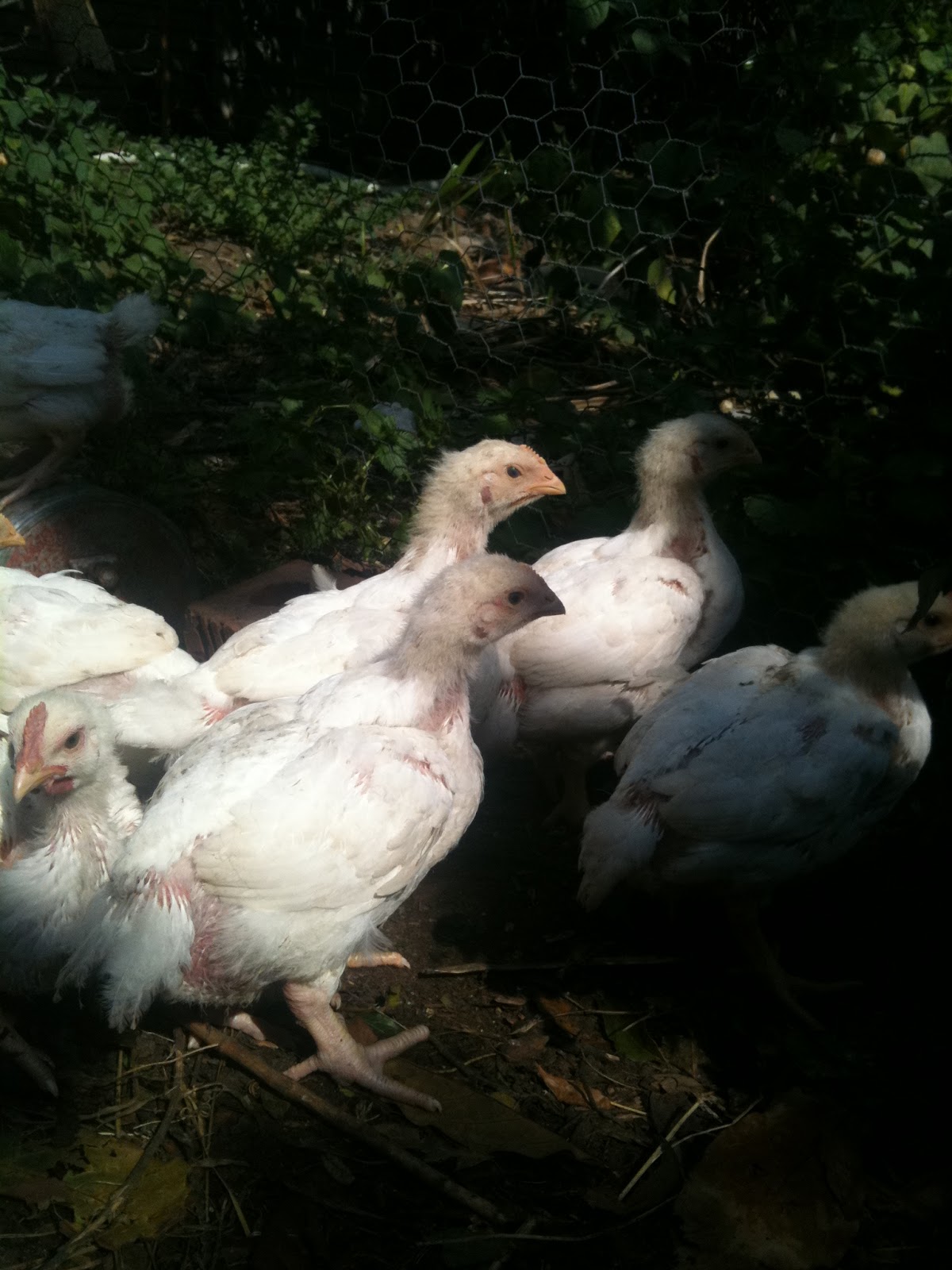
Broilers at 2 and a half weeks. They really like the pen. They flap their wings they do little short sprints as if testing their legs. They scratch the grass and peck for bugs and stuff.

Freedom, what is it? Is it something we find? Is it something we fight for? It could be, but here we talk about freedom as something we build for ourselves in our own lives everyday.
Broilers at 2 and a half weeks. They really like the pen. They flap their wings they do little short sprints as if testing their legs. They scratch the grass and peck for bugs and stuff.

Mom sets up her chicken operation in the Wilderniss forest.
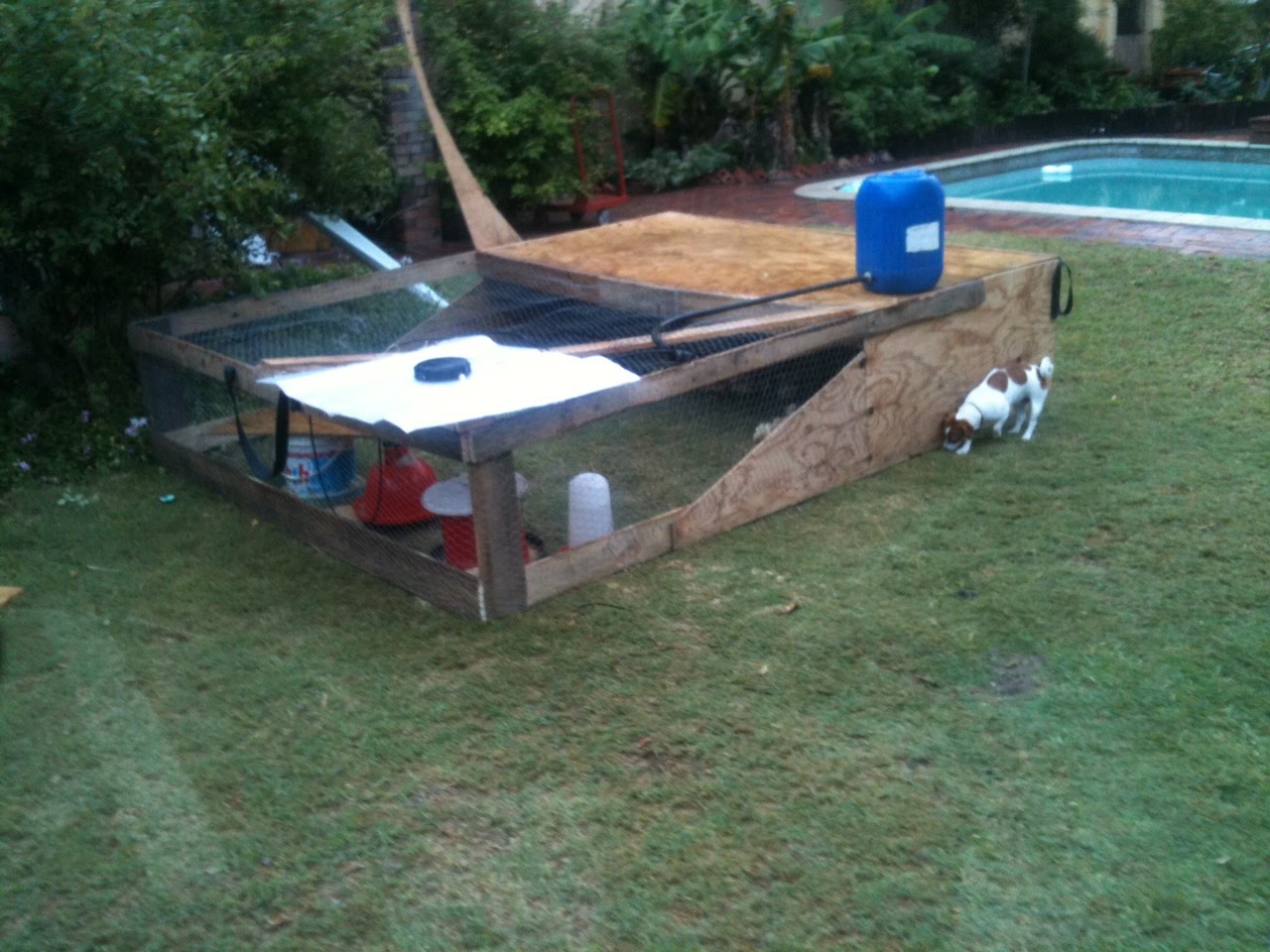
Moveable pen set up. Chicks in. 2 weeks old, Just out of brooder.

It is built of old packing cases from Port Elizabeth’s motor industry.
Our home broiler project went quite well.
There are a number of steps in the process and I know that the best way to learn is to go through it in practice.
Its the second pilot that we have done. The first started with 30 day old chicks. This on started with 200.
Other than the scale what did we do differently this time.
1. We got the day olds from a proper supplier, not the pet shop in Korsten
2. We used better waterer’s and feeders,
3. We made food available constantly and not three times a day as we did in the first pilot.
4. We had the chickens processed by a small abattoir – Christo Els near Uitehage. – He did a great Job.
5. We fed the chickens a lot of greens – especially – Duckweed, which I scooped from pond alongside.
6. We sold (or ate) 125 chickens for R35.00 per kg. (higher than before)
7. We were able to pasture the birds a little with mobile pens.
I am happy about the following:
We had some problems that I would like to fix next time:
I am busy think about the next step. But I quite enjoyed learning from this one.
This piece first appeared inThe Herald (Port Elizabeth) on 8 December 2010. |
| Nguni Matroos, the one armed geriatric Tsistikama farmer,…an inspiration! |
Minister Ebrahim Pattel proposes that the salaries of the rich are frozen. While it is easy to see how this move would score points with the labour movement, the Minister has not argued how this limitation will address the challenge of poverty. We speak a lot about poverty in South Africa.y, rural poverty, “endemic poverty”, “entrenched poverty”. In talking, we have almost abstracted poverty; elevated to the status of an issue. Something requiring the world’s attention like global warming or rain forests. But how much do we really know about poverty? We think we know what poverty is. Surely the answer is obvious. But is it? South Africa like other developing countries are today the front-line, we are at the battlefront of the war against poverty. Here, poverty is real, tangible and palpable. This is not the case in Japan, New Zealand or Sweden. Our friends in those countries can be forgiven for assuming and arms length theoretical view of poverty. But for us in Africa, we have got to develop an understanding of poverty useful enough, to use to take action. Poverty is a problem effecting real people with real lives. I have slowly begun to grasp that we often think of poverty as the “inability to consume”. We think that poverty is simply that we haven’t got enough stuff or the money to buy stuff. But I wonder if it would not be better to understand the “inability to consume” rather as the symptom of the problem we are trying to solve. Would it not be more useful for us to see that it is the continued inability to produce and be productive that is the root of poverty?
This piece first appeared in The Herald on 5 November 2010.
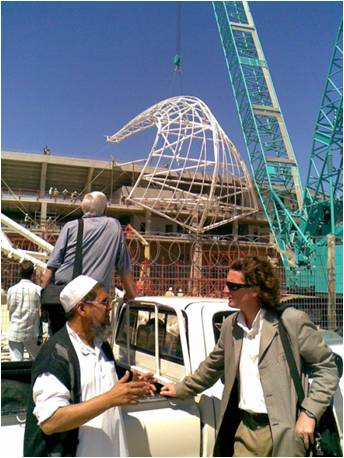 |
| Tim Chats to Engineer, Hashiem Agerdien, as the private sector hoists the first truss at the state funded, NMBM Stadium |
AT first Cabinet’s new growth plan seems unlikely: five million jobs in 10 years. Finance Minister Pravan Gordhan makes it clear the bulk of these jobs will be delivered by business. Is this even possible?
If we are to achieve the jobs target laid down by our president, we would see unemployment dropping from its current levels at 25% to a level closer to 15% by 2020. This equates to a 10% improvement.
So, simplistically, it seems, that if I have a business that employs 20 people, to achieve my share of the target today I would have to employ another two people (a 10% improvement). Suddenly, it seems a little more possible.
But, if it is we in business who have to deliver on these targets, are we up to it? Do we have what it takes? I would say we do, but there will have to be some serious changes made.
Firstly, we in business will have to stop being mediocre. We need to realise we must be world class – from the sign at our entrance, to the kettle in our tea- room, to the management systems we put in place.
We cannot continue to do as we have done because “we have always done it that way”. We must improve continuously. Read. Travel. Find out what best practice is and change our organisations for the better.
Secondly, we must stop our obsession with easy money, dodgy tenders and incentive schemes. There are more than enough real business opportunities with real demand for us to pursue.
Spending all our time brown-nosing people, claiming they can “get you a tender” or “fix you a deal”, is a big mistake. Let us spend our time building our businesses.
If there is a tender advert in the Sunday Times, let us put in our bid like everyone else. Let our achievements and capacity speak for themselves.
Thirdly, we must stop whinging. Sure, we’ve got poor leadership and we’ve got corruption. Get over it!
Don’t let that stand in our way of being excellent. Don’t complain. Do something! As a business you can do a lot more than an ordinary voter:
You can fund a campaign or a political party.
You can leverage your profile in business to run for public office.
You can use your profile to put your perspective across to leaders at a meaningful level.
Don’t complain, don’t whinge. Take action!
The business sector has a lot of work to do, but there is critical support we need. Government has provided the leadership to set the jobs target, but business needs a little more from them than that.
Firstly, can the business sector get a little more credit for the role we have played and continue to play in transforming this country? We are a key part of this country’s success.
Can you cut us some slack? There are rotten apples in the business, just like in government, but please, the word “businessman” is not synonymous with “bourgeoisie capitalist pig”!
Government does not need to choose between being friends with business or with labour, but just know that, by definition, labour cannot create jobs. As soon as labour creates a job, it is no longer labour, but business.
Secondly, government, don’t scratch your head trying to think what new programmes you should dream up to create jobs. Rather, let’s focus on doing what you have already promised to do.
There are some big job-stealing problems that you need to get right like education, crime and public transport, but there are small things that government officials and elected representatives can and must do immediately. It may help if they are pointed out:
Make decisions;
Make sure the water runs when we turn the tap;
Make sure the light goes on when we flick the switch;
Answer your phone;
Return your calls;
Reply to your e-mail;
Fire those that are incompetent;
Promote those that excel;
Process applications;
Issue permits;
Pay us when you buy something from us (on time); and
Spend your budgets.
Get these things right so business can go ahead and create jobs. You are slowing us down.
Like US president John F Kennedy, famously setting a target in the ’60s to put a man on the moon “before this decade is out”, our president’s act of setting a target has an already added value by getting you and I thinking about how to get it done. But now, we must act.
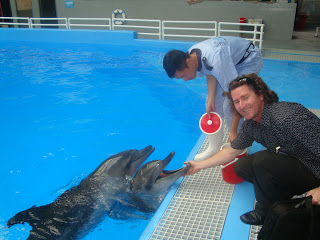
During a recent trip to Hong Kong, I met with the management of Ocean Park, where Port Elizabeth’s, Bayworld dolphins: Domino and Dumisa are being cared for. My objective with the visit was to gain some practical planning tips that we could use in finalising the design in preparation for when Bayworld goes into its much awaited and anticipated construction stage. I came away from my time in Hong Kong very impressed with the facilities and infrastructure at Ocean Park.
Domino is participating in live shows in a 500 seat, roofed grandstand and Dumisa has the onerous task of making dolphin babies. I was privileged to be taken “behind the scenes” into a climate controlled facility with a series of 9 or 10 inter-leading pools which make up their renowned captive breeding programme. I was impressed with the care taken to every detail. The special poolside finishes, with water jets ensuring smoothness on the dolphin’s skin, the hydraulic, adjustable level floor in the examination pool, the strategically located chemical footbaths to avoid contamination being tramped in on handlers and scientists shoes. All very impressive.
But, as I sat at the cavernous Hong Kong International, waiting for my flight home, I began to reflect on my few days in Hong Kong and my week in mainland China before that. I began to wonder what it is that the Chinese have, that we don’t have, that has enabled them to provide such great care for South Africa’s dolphins. What has enabled them to build such a miraculous economy with all the infrastructure, bells and whistles that go with it? As I boarded the plane for the 13 hour flight back to Johannesburg, I cast my mind back to the week I had spent in Chengdu before arriving in Hong Kong. Chengdu is a 2500 year old city of 11 million people. Bigger and older than London, but not even on the list of China’s top 10 biggest cities! Development is happening everywhere. It seems cities are being systematically re-built, to an ever elevated specification and higher standard.
As I ate my airline portion of “chicken or beef”, I felt saddened that we were not able, in Port Elizabeth, to provide the care and facilities that, our dolphins, Domino and Dumisa are accessing in Hong Kong. Over the years, Port Elizabeth’s Bayworld did an almost miraculous job with very little. But in the end, the system we have built, the society we have created, could not the provide the support required to sustain a healthy captive Dolphin population in Port Elizabeth. We had failed.
But why had we failed? I was not certain.
I had travelled to Hong Kong in an attempt to acquire “know how” from the designers and managers of Ocean Park. I came back with a supply of very useful information and valuable tips, but I also came back with the knowledge that our problem at Bayworld, our problem in Nelson Mandela Bay, our problem in South Africa, is in fact not a shortage of “know how”, but rather a lack of vision of a shortage of will .
It is a selective lack and shortage. It is evident that we, as a country, are not incapable of developing a clear vision and a strong will. The 2010 Fifa World Cup, managed to collect South Africans around a specific “vision”. We all witnessed a sufficient supply of “will” to see us building the world’s best stadia and top class infrastructure. Given sufficient urgency, we are capable. It just seems that China has sufficient urgency over a far broader range of social objectives and can sustain it over a far greater length of time. China had the will to emerge from poverty and famine in the 1960’s. China (more mainland China than Hong Kong) had the vision of a better life for its people. In order to achieve this vision, they have developed some characteristics from which South Africa could perhaps take lessons:
o China has a strong and decisive state at all levels
o China has set out to ensure that all its citizens are able to be productive in some way.
o China set out to control its population at levels where it can ensure prosperity.
Importantly, much of what had to be done to pull China out of poverty would have been very unpopular to implement. Nobody wants to have a bossy government, nobody wants to work hard and nobody wants to stop making babies. But everybody benefits from a prosperous country free of famine.
So, perhaps after all that, I say to Bayworld, the Nelson Mandela Metro, Provincial Government and National Government: We, as a city, do have enough “know how” to turn Bayworld (and the entire city) into a world class destination. With enough urgency the budget will be found. What we are lacking at the correct level, is a clear vision and sufficient will to see it happen. Our country deserves this. Our citizens should demand it.
The new calves we Gerrie has weaned for us arrived on Saturday. We put them in the bull camp at Tsitsikama. It was bit of a problem, because they did not want to stay in, they wanted to go home, they knew they were not where they were the previous nioght. they kep walking through the fences that had quite effectively kept the other calves in for months.
 TimHewitt-Coleman.com