Goedmoedsfontein

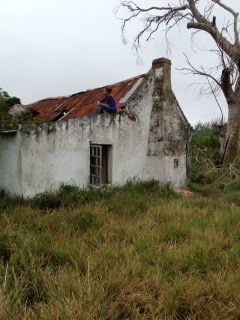
Its been at least two years now that I have been trying to buy the farm Goedmoedsfontien. Its a 10 Hectare property near Coleen Glen about 20km from Port Elizabeth. The land is on the base of a south facing hill. The remaining part of the original farm from which other parts have been subdivided over the years. Parts of the house are really old. The farm was first granted to a Mr Kok in 1816. He may have built this house shortly after that. I am still doing some research to find out with certainty.

The farm has some pasture  some forest and some wet land. There are two springs and a stream running though the property. The two streams I believe feed the Kragga Kamma river after which the area is named.

My intention is to restore the farm into a mixed farm with indigenous Nguni cattle, boerbok goats and local sheep breeds. I intend to manage the forest and perhaps run a small free range pork operation. I have some experience with pastured poultry. the farm will definitely be suited to this.

Right now the farm is overrun with invasive alien trees and I have started to work of clearing these. The farmhouse is not yet accessible by car and I am building a new route from the road about 200 m from to the house. Its is very sensitive work as the road has to cross the stream that runs from the spring. There are number of beautiful indigenous forest trees that the driveway must avoid. This too adds to the complexity.

The cottage has been abandoned for many years and needs a lot of hands on work restoring it the roof needs to be replaced along with windows doors and floor boards.

Some of th walls are of mud brick construction and need a careful and caring approach to restore them.

I have now secured an “option” to purchase the farm by September 2013.

I have had to pay for the option so I am risking quite a bit of cash.

The reason I cannot buy the farm without the option is because the banks will not offer finance on “vacant land”. The house is really in a bad state and I intend to spend the next months fixing up the house and the farm to the point where we are able to convince the banks to provide finance.

If they don’t, the sellers will proceed with their attempts to sub dived the farm into three portions and sell them off to “lifestyle” buyers. I am afraid with such small subdivisions no real farming is possible. (even 10 Ha is pushing it)

So this is my mission for the next six months.

I am going to need all the help I can get to save the farm and save me from loosing what I have put in.

I am now actively calling for volunteers to assist.

If you would like to get involved in some way, please contact me at tim@noharchitects.co.za

February 2013 – Newsletter for the Eastern Cape Institute of Architects

February 2013
Dear Colleagues,
February has been a surprisingly positive month for our city. We have “close to capacity” crowds watching our local team engaged in world class rugby at our world class stadium, we have a municipal manager appointed for the first time in three years and we have Sun International officially opening the new conference centre and five star hotel at the Boardwalk complex in Summerstrand. These are all very encouraging signs of growth, stability and revival in a city in which we all believe.


In fact, I was fortunate to be a guest at this weekend’s opening ceremony for the new and improved Boardwalk complex. But, as I sat at the glitzy, over-the-top, launch function, I could not help but notice those things that architects notice. Yes of course the design of the imposing dolls house façade of the 5 star hotel, is not to everyone’s taste. (In fact it is not to my taste at all, but I expect there are a good number of paying customers whose view is a greater consideration to South Africa’s premier hotel and leisure developer.) But as the function progressed and the mandatory speeches of the politically powerful drew on into the evening, the design issues moved further and further from the front of my mind. Rather, I began to think of the role of our local, Port Elizabeth based, professionals in the project. The project was carried out by a full team of local consultants: structural, civil, town planners, mechanical and electrical engineers. Except for the Architects, where the work was carried out by two Johannesburg based firms. (Yes, there was some “local” architectural support, but only a very small, limited appointment.)
As I contemplated the over-catered exotic foods, the scantily clad waitrons and the exuberant fireworks display that evening, I could not help but to become a little anxious of a pattern I have noticed, where any project of significance in this town requires the leadership and vision of some outside Architectural firm. We see it with the Capetonians at the new Baywest Shopping Centre, we saw it at the North End Stadium with the Germans, we see it now at the Boardwalk and even at the NMMU, where the prized commissions are snapped up by Cape Town or Johannesburg firms.
But, what to do? Can this tendency by reversed?  I, for one, have long given up on the futile idea of trying to defend “our territory” against outsiders. Why? Because this sword cuts both ways. Many architects in our region are doing good work outside of our region and outside of our country, making it insincere and contradictory to argue that we should not be open for business to Architects from outside of our region and our country. Rather, I think we must embrace the reality that the world in which we live is a world of specialisation. We have got to get good at something and to be seen to be good at that thing. There is absolutely no reason why you cannot be based in Port Elizabeth and be recognised as the world’s best in some aspect of design and construction. This, I believe, must be our focus as an Institute. We must be seen to be pushing for the conditions that would enable our members to deliver cutting edge work of the highest order. This is how we remain relevant; this is how we remain competitive. All other “protectionist” strategies are for the short term and eventually tend toward making us weak and lazy. We can’t afford to be weakened any more than we are. Its not an option.
A few years ago I visited the Cairn’s Convention Centre on the north east Australian coast. We were investigating the potential for an International Convention Centre here in Port Elizabeth and we were told we had to visit Cairns as their centre had been voted the world’s best four times in a row. Now bear in mind that Cairns has the population less than Uitenhage and airport the size of Upington’s. The sea is un-swimmable because the mud and mangroves. There is nothing really special about the town at all, but because of the commitment of the town’s leaders to provide an excellent international conference experience, the place is booked out year after year by big spending international conferences.
So, can PE become to the world of Architectural Design, what Cairns is to tourism? Well, I don’t know. But if the answer is “no”, then it is not “no” because we are too small a city, it is not “no” because our airport is too small, it is not “no” because Cape Town is hipper or Jo’burg shinier. If we decide that we want to develop our city as having a reputation for excellent design, for sustainable design, for sensitive Heritage design, for urban renewal, for people focussed “developmental” design, then we better get going with it. We had better get going with figuring out what the first step is, because it ispossible. Or we could then of course just do nothing, leave things to chance and winge to each other as our profession is eroded by “outsiders”, “experts” and hostile clients.
I think, I would prefer that we don’t do nothing. We have tried that for some years now. It’s got us where we are now.
But more importantly; what do you think?
Yours in Architectural Excellence
Tim Hewitt-Coleman
(President – East Cape Institute of Architects)

January 2013 newsletter for the Eastern Cape Institute of Architects

January 2013
Dear Colleagues

,
Welcome to the first Newsletter for the year from the Eastern Cape Institute of Architects. We will be sending out these communications monthly, in order to give a view of what is topical to our profession and to the built environment. 
If you are anything like me then you already have too much information coming to your desk and you can’t stomach the idea of another monthly mail that you wont get around to reading. I urge you please to see this Newsletter rather as a time saving device, a view of what you should look into in greater depth and what you could perhaps come back to later.
·         The ECIA has a very useful website (www.ecia.co.za) (thanks Jacques van Tonder) All important notices, memos and minutes are stored there for you to browse through at your leisure. The newsletter will not duplicate that information, but rather highlight what may be most relevant or pressing.
·         The ECIA now has an active Facebook page (thanks Jo Staats). This is an ideal forum for members to engage in debate and discussion around issues relevant to us in our work as Architects. Please “like” the page “Eastern Cape Institute of Architects”
·         You can follow the ECIA on twitter @ECIAPE (Please do). Jo Staats is in control of this feed and posts only quality information there for us.
·         The ECIA has begun to post videos of lectures you may not have been able to attend. These can be found on Youtube (thanks Tarique Abdul) at
“So what does the year have in store for us?”
January would not be complete without us pondering this question. Let me offer you my view, so we can see how different it is to yours. The truth is, I see a good year ahead.  I say this sincerely and I say it for the following reasons:
·         I see a consensus developing that the worst of the economic downturn is now behind us and that the public and private sector are starting to build buildings again. House prices are beginning to rise and there are some reports coming through of agents reporting stock shortages especially at the lower end of the market. Shortage of stock means new buildings have got to be built and that means business for Architects.
·         I also see that we are heading for national elections next year, and when I look back at the last three national, there was a definite spike in urgency from the public sector developers in the year or so before. I predict we will see the same this time around and have already begun to see evidence of renewed vigour in stalled or sluggish projects.
·         I predict that the political impasse that has crippled Nelson Mandela Bay’s administration of the last few years, will in the coming months find resolution. I see this as an unexpected by-product of the Manguang conference, where our Mayor, Zanuxolo Wayile, visibly supported the winning  “Zuma” faction and his arch rival, regional political boss Nceba Faku, vociferously backed the Monlante  “loosing horse”. Why is this important for Architects to watch? Because it now becomes more likely that the ANC in the region will rally behind our mayor knowing that he is on a winning wicket; and a Mayor with strong support in his own party is a mayor who can be decisive and effective. And we all know that getting buildings built requires decisive and effective leadership. We will watch this space eagerly.
·         The other dynamic I am watching carefully is the tragedy of dramatically low fee tenders that are being accepted by many of our clients. In the past year the MBDA and National Department of Public Works accepting tenders with 40 and 50 percent fee discounts. There are only two possible outcome of this trend:
o    the first outcome sees firms continue to offer the service that we have traditionally expected the architect to provide, but find their expenses outstripping their income leading to inevitable business collapse.
o    The second outcome sees firms compromise dramatically on quality of service. Working ‘to rule’ but in the process damaging the built environment and the long standing good reputation of the Architect as a professional.
Controversially, perhaps, I would argue that both of these outcomes will lead to corrections that would improve prospects for Architects in the longer term. The first outcome will see Architects tendering too low punished with business failure, leaving those that survive to continue, but at more realistic rates.  The second outcome, will see client organisations looking more carefully at their procurement systems to protect themselves against the inevitable poor service that emanates from a tender process that emphasises lowest price above all else.
Whatever happens, 2013 promises to be full of excitement? We have an excellent committee elected at the AGM toward the end of last year. This new team will build on the success and the momentum of Professor Albrecht Herholdt’s 2011/2012 committee. This committee is made up of: Albrecht Herholdt, Andrew Palframan, Bandile Boyana, Debbie Wintermeyer, Jacques van Tonder, Johann Staats, Mary Mangan, Neill Kievit, Nicola Darke, Tim Hewitt-Coleman
These people have all volunteered their time and energy to the cause of the Architectural Profession in the region. Please support them in their task by taking them into your confidence by sharing your frustrations, dreams and ideas.
Colleagues, lastly, please remember that we run the Merit awards programme this year. (thanks Andrew Palfarman and Debbie Wintermeyer) You will be called upon later in the year to submit your best work for a panel of expert judges to assess. Yes, it’s scary, but please participate. This process of peer review and peer recognition is part of what makes our profession great.
Thank you.
Yours in Architectural Excellence
Tim Hewitt-Coleman
(President – East Cape Institute of Architects)

Walmer Tilapia Hatchery

The first batch of my tank bred  red strain Mozambique Tilapia (Oreochromis mossambicus)
have now reached about 5 cm each. They seem better adapted to the tank environment and take both commercial feed and duckweed quite well. I am still keeping the ordinary grey ones though and may play with the idea of crossing them to see what happens.

Walmer Tilapia Hatchery


Photo: Major disaster this morning in the Tilapia Hatchery. Water levels went lower than the bubbler leaving fish starved for oxygen. Sadly these fish are now contributing their nutrients to the compost heap.

Major disaster this morning in the Tilapia Hatchery. Water levels in the outside 1 kl went lower than the bubbler leaving fish starved for oxygen. Sadly these fish are now contributing their nutrients to the compost heap. Perhaps I lost half the fish, there are still many quite healthy. I also lost two gold fish that had become quite big in the tank.

I have now changed the bubbler set up in such a way that it can never be exposed above the water level. But the system is being tweaked and adjusted with every mistake I make. I have made a lot of mistakes!

Central, Port Elizabeth – Blueprint for metro’s urban future?

I tend to go on a bit about the form and shape of our cities. I find myself speaking about better cities, greener cities and walkable neighbourhoods wherever I can and whenever I can. But, I have come to see that perhaps the idea of a new urban future is not so easy for most of us to visualise.
In a small meeting last week with very intelligent Phd’s, business champions and students of literature, a colleague and old friend confronted me: “What do you mean by “re-imagining the city”. Do you mean building winding streets rather than straight streets?” My friend could not see that changing the form of the city would have any impact on the lives of ordinary people. His frank question helped me see that the important work of building consensus on what our cities of the future should look like has not yet even begun. The ideas are there, but they are stuck in the minds, books and blogs of the brilliant few. The brilliant few however don’t build cities; they tend rather to spend most of their time arguing with each other.
I have decided to come to the aid of the brilliant few in attempting to build consensus. I have also come to see that looking back at our history exposes us to a laboratory of urban experiments, some that worked and some that did not. Looking in to the future on the other hand, is of course very confusing, untested and most of all; impossible.
I love Central Port Elizabeth.
I love the cool shade of Trinder Square. I love the antique shops of Lawrence Street. I love the galleries, museums and courthouses. I look through the grime and the vice to the underlying physical and spatial structure. Central is a living, breathing lesson in urbanism. It is a lesson from the past about how we can build the cities of our future. Let us consider Central for a minute:
·       Vibrant mix of Offices, residences and shops
·       Comfortable mix of old and young
·       Street life and café culture
·       Nightlife and youth culture
·       Rare mix of rich and poor
·       Healthy mix of rental and freehold
·       Hospitals, churches, schools, buses, taxis, shops and parks all in walking distance
I am not looking at Central as something that needs to be protected like a museum. I am pointing to Central as a contemporary model of urban land use, a model of mixed use and a model of car management that should be replicated throughout our metro, (or at very least along the corridors that now become supported by public transport)
Providing roads, sewer, water and electricity is cheaper in Central than in Sherwood or in NU5, because taller buildings and higher densities mean less infrastructure cost. Central has proportionately less streets to sweep and fewer bins to collect. We know that higher density environments are much more efficient for the public and private sector to service. About this there is no disagreement.
So, if Central is efficient, if Central is green, if Central is pro-poor, if Central is fun, if Central is beautiful, why can’t we see to it that we build more neighbourhood’s like Central?
The answer quite simply, ladies and gentlemen, lies in a very powerful little document called the “Port Elizabeth Zoning Scheme”. Authored in the 1960’s by nameless champions of suburbia and reworked and edited over the years by technical types seeking to close loopholes; The Port Elizabeth Zoning Scheme sets out what you may and may not do on your own property. It may allow you to work there, but not sleep there. It may allow you to pray there, but not shop there. It may compel you to build 10 m away from your boundary or it may compel you to provide hundreds of parking bays on your site for the shop you choose to build.
Central was designed before our contemporary obsession with the motor car. Central was designed at a time when walking was the dominant means of transport, (supported by public transport for longer distances). Central was designed at a time when we understood that it is illogical for each city dweller to plant a quarter acre of lawn in front of each of their homes. Suburbs like Newton Park or Kwadwesi will never become like Central because of the provisions of the Port Elizabeth Zoning Scheme (and other schemes like it). The Zoning Scheme requires that millions of Rands be thrown into parking basements, setbacks and building lines. The Zoning scheme encourages single use sterility. The Zoning scheme discourages mixing of rich and poor (you try build an affordable, Central style block of flats on your site in Walmer and see how far you get!)
I am not suggesting here that we abandon our tradition of orderly city building, but I do suggest that we do not continue to let our city be designed by a faceless, anonymous and hugely outdated rulebook. I put it to the readers of this column, that we must be clear when engaging the municipality. We want our city to look and feel like Central. If they have rules on their books that stand in the way of this then those rules are of no use to us.
We are fortunate to have Central. It is full of life, it is full of hope and it is full of lessons.

This column first appeared in The Herald, Port Elizabeth, 29 November 2012

Walmer Vinyard

I have been working for a few weeks now on cleaning up the vine on my east boundary.

The vine has been there for a long time. When we moved in 13 years ago it was already very established and giving small purple blackish fruit. The I count three vines, with a least one on the neigbours side of the fence.

I intend to make wine from these grapes come Feb or March next year.

The best gues so far is that the cultivar is a Catawaba. This cultivar comes from America. When I googl Catawaba, it does come up with a number of sites trying to popularise the wine.

Interestingly though, when I went to the Nursery a few weeks ago to buy 4 new vines, the only red cultivar that they had available was Catawaba. Perhaps the nursery man their knows a thing or two about suitability to the Port Elizbeth climate.

Which brings me to the Theescome wine estate that i visited last week. Sandra there is making wines from four cultivars – Pinotage, Cabernet Sauvingon and two whites. here vinyard is only two hectars in extent!

Climate therefor does not seem to be an impossible impediment in Port Elizabeth.

I can be worked around!