Tao of the Farm – Principle number 4: “You are not the first person to plant a lemon tree”

Hlubi and I this weekend visited “Babylonstoren, a beautiful wine farm somewhere between Paarl and Stellenbosch. It has beautiful vineyards and fine examples of historic Cape Dutch architecture, but more than anything else, it is the gardens that leave a lasting impression. The three hectare garden is expansive and is set out as a long rectilinear grid and irrigated with a water channel that runs along is length down the gently slope.
Annuals and Perennials, Fruit, vegetables and Herbs

The gravel pathways form blocks which frame different zones of fruits, vegetables, poultry, herbs and flowers. It is a beautiful place, but at the same time is a fully functional, productive garden producing the highest quality produce for the three restaurants and shop on the site. The gardener is highly knowledgeable, as have been the gardeners that took care of gardens just like Babylonstonern in the cape since the time on the Company Gardens in Cape Town in the 1600s. The point of course is that gardening is not something new. People have been perfecting this art for thousands of years. Each generation of gardeners has worked to make slight improvements and modifications to the work of the previous generation. No successful gardener has ever plunged themselves into an open field armed with only muscles and a spade. Of course effort is the key ingredient. But in as much as Law of the Farm Number 3 is true when it says that reading about sheep does not make you a shepherd, it is also true that there is a huge volume of information available to be passed on about any conceivable subject, including becoming a shepherd and including planting a garden.

The central gravel access path

At Pebblespring Farm, I have planted one or two lemon trees, but I simply don’t have 10 years to wait to see if this particular variety grows well in the particular spot I have chosen for it, with its particular soil and moisture characteristics. To short cut this process, I talk to other gardeners, I read books, I Google, I travel to Cape Town and visit places like Babylonstoren. Why? Because its all been done before and if I am thorough in my research, I will be sure to able to take advantage of the learning hundreds, perhaps thousands of years of lemon tree planters across the world. By playing my cards right I can obtain the power and clarity that would otherwise only be available to me if I had lived for many generations.
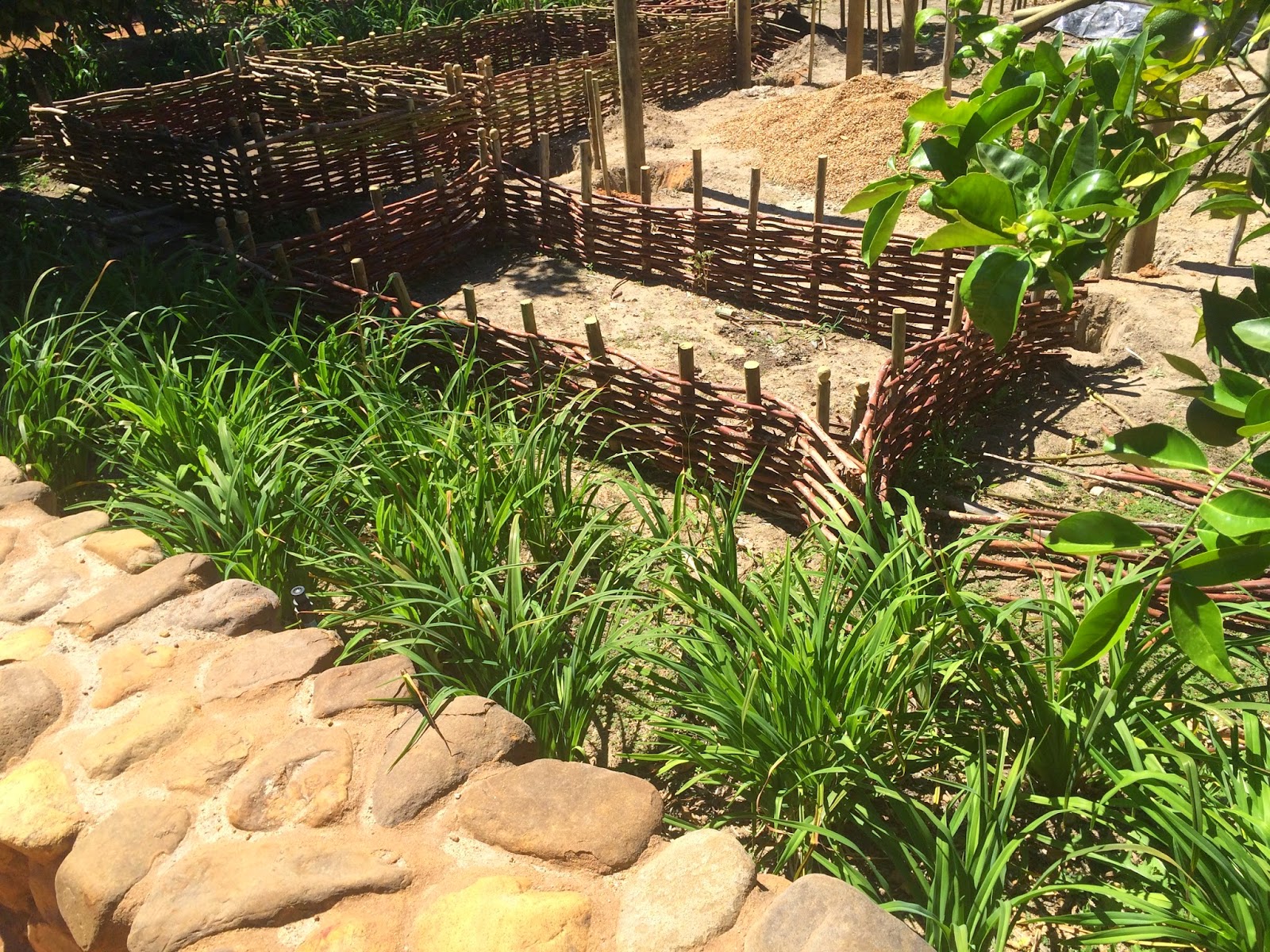
An abundance of texture and colour

This is of course true whether I am interested in planting lemon trees, learning the art of Kung Fu or the craft of knitting a jersey. Invariably what we are trying to do has already been done, and if we look hard enough we are able to find the stories of those that have done it. I have seen though in my own life, that finding the information is not difficult. What is often difficult for me is that, faced with the huge quantity of available information, the process of trying to consume it becomes all consuming. The balance between research and action becomes distorted and I end up binging on information: books, movies, travel, blogs tweets and Facebook pages. In the same way perhaps as the obese load up with so much energy giving food that they eventually become so heavy that they are not able to move to use up the energy, causing them to become immobile and to the point where the only action they are capable of is to take in more food.

My view then is that we must rather be led by action than be led by research. Let us push forward with our mission to the point where we can see that we can no longer advance because of our lack of knowledge. We will know when we have reached this point because a question will begin to formulate in our mind. We will start digging the hole for the lemon tree, and a question will begin to formulate. “How deep should this hole be?” Once we know the question, it’s quite easy for us to know where to look and to find the answer. The research then directs our next action. We dig the hole to the required depth only to be faced with the question of soil preparation. Should we fill the hole with compost, or should it be manure? Do we need to increase the acidity; do we need to make it more alkaline? As we proceed in our action, we are prompted in research. The research then  prompts us into further action. It sounds obvious I know, but actually what I am suggesting is completely in contradiction to our contemporary education system which at very least creates the impression in people’s minds that education and training is what happens in that part of your life before you start working. So, we” frontend” twelve or seventeen years of schooling into a young life at an age where working is frowned upon and even illegal. Once this stage is over, we enter our working lives where research is most often seen as a diversion or a destructive waste of time to the point where Google may be disabled on your company PC.
But don’t worry about all of that. Rather you just be sure that:
·         Number one, you know your mission.
·         Number two, you take the first step.
·         Number three, you recognise when you are stuck,
·         Number four, you find answers to the questions required to get you unstuck.
·         Then proceed, re-check to be sure that you are still on mission and repeat steps one to four.
You can’t go wrong!


Tao of the farm – Principle number 24: “Some low life will steal you chainsaw.”

After this month’s livestock auction on Saturday morning, we stopped off at the farm on the way home. I noticed that the front door of the cottage, which is off its hinges for painting, was lying flat on the floor of the cottage. Normally it’s propped up in the door frame. It had been quite windy on Friday so, I dismissed it, but could not help to feel a little suspicious. I unlocked the store room, immediately looking for the chainsaw. I looked high and low scratching through boxes and unlikely places in some kind of denial and disbelief.  It is nowhere to be found. Mandoza says he last used it on Thursday. He suspects the casual labourer that we employed the week before. A guy called “Sticks”


The door to the storeroom was not forced open, it had been opened with a key and the key had been returned to its normal hiding place. Mandoza thinks that Sticks may have seen the hiding place for the keys. Anyway, I am really upset. I am angry that we have thieves moving around on the farm, I am angry with myself for not being more vigilant with security and I am worried that I now have to find money to replace this piece of equipment that I really liked. In this soup of emotions that are now still floating through my brain as I write this on Monday morning in the coffee shop just up the road from my office. As I sit here in the smoky interior with the familiar seventies music soothing softly in the background, I struggle to remind myself of Law of the farm number 24: “Some low life will steal your chainsaw” Or as some American hippy once said “shit happens”. The mongoose will eat your hens, the bubbler in your Tilapia tank will fail, ticks will infest your cattle. These setbacks are constants. They will happen. The extent to which they happen and the degree of damage they cause may be variable, but they will happen. I try to console myself with the truth of this law. It helps a little, but maybe tomorrow I will be OK. Maybe tomorrow I will come to see that we have become softened by the illusion of comfort offered to us by our lives. Perhaps I will come to see that we are lead to believe that nothing can go wrong. Everything happens at the flick of a switch. Even here in South Africa, and especially if you are urban and middle-class, you may go through very long periods of time where nothing ever goes wrong. The bottle store never runs out of beer, the soccer is on the television every Saturday, the mall keeps it opening times as advertised and the lotto draw happens as scheduled every weekend. When things go wrong, they are small, they are temporary and we are shielded from the crisis, by layers of government and corporate structures. When the farmer’s potato crop is destroyed by a swarm of locusts, we somehow magically still get our Lays lightly salted from the all night convenience store. The massive corporate chain makes sure they import potatoes from some other part of the province or some other part of the world, we do not so much as notice a difference in crispness of our favourite snack. 

Everything we consume is in this way filtered to be free of risk, to the extent that when our restaurant scrambled eggs aren’t exactly the correct degree of softness, we feel completely obliged and entitled to feel miserable and to throw a tantrum. What I am saying is that governments and corporations have very effectively come to create the illusion that rule of the farm number 24 does not exist. It does. Some low life will steal your chainsaw, and the sooner you (and I) wake up an begin to live and plan our lives according to this law, this non-negotiable constant, the sooner we can be more closely aligned with the way things work. Delusion may be comfortable, but making peace with the brutal truth brings us into closer union with the universe and its laws. And in this way we make ourselves free, not by selling ourselves into slavery to pay for the cost of the triple insurance premiums of comfort, safety and security.

Snakes Alive!

Of course we have lots to fear in this life. There are so many ways in which we can get hurt, killed, robbed  or betrayed. Everyday we are exposed to danger. Motorcars are viscous killers. Any home contains all kinds of ordinary looking things that can kill us if we are not careful. And I am not even talking about rat poison or pool acid, just ordinary stuff, which when taken in the wrong quantities can kill us, like vodka, or paracetamol or lying  in a bath. But it is of course not logical or acceptable to live in fear of bathwater, electricity or a motor car just because it can, in certain circumstances, be deadly. It seems though that we discriminate differently between Urban dangers and rural dangers. Or so it seems this week with the excitement caused by the appearance of two (very small) snakes in our rainwater tank. I have builders working on site and they were terrified. It effected their work. Some in my family too, (I dont want to mention any names) are hinting at not ever returning to the farm that is loved by all of so much. Of course I as a husband and a father must make every effort to understand that not all of us are the same and that some and may have different loves and fears. I understand this. It is not good enough for me to explain that as we warm up into summer, the snakes will be on the move and we should be on the look out.

Anyway, the snakes turned out to be two Spotted Bush Snakes Philothamnus semivariegatus. (thanks to the people at snakesofsouthafrica for help with the identification) which are not poisonous at all. There are dangerous snakes on the farm, like the Puffaders that like to lie on a sunny path waiting to be stepped on. What I am trying to say though, is that we are confronted everyday with a strong bombardment of ideas of what is “normal” and what is not. We are told that “Normal” is to work in a cubicle, commute to work in a Toyota Corrola, and watch rugby on Saturdays. So it is with normal dangers that confront us every day in the city. Because they are “normal” we tolerate them. Even when they kill us, we continue to tolerate them. But snakes, scorpions and frogs are “abnormal” dangers and they are to be eradicated, chopped into little pieces, burned, poisoned and obliterated. Such is the logic of our time.

So, while I can see that all this, to keep the peace I have had to make a visible effort to do something about the snakes. So I have cleared all the longer grass around the house and reduced the number of places snakes can hide. And also very cleverly I have installed a very innovative anti snake device onto my watertank.

You can watch the video if you like.

So, How have the cows been?

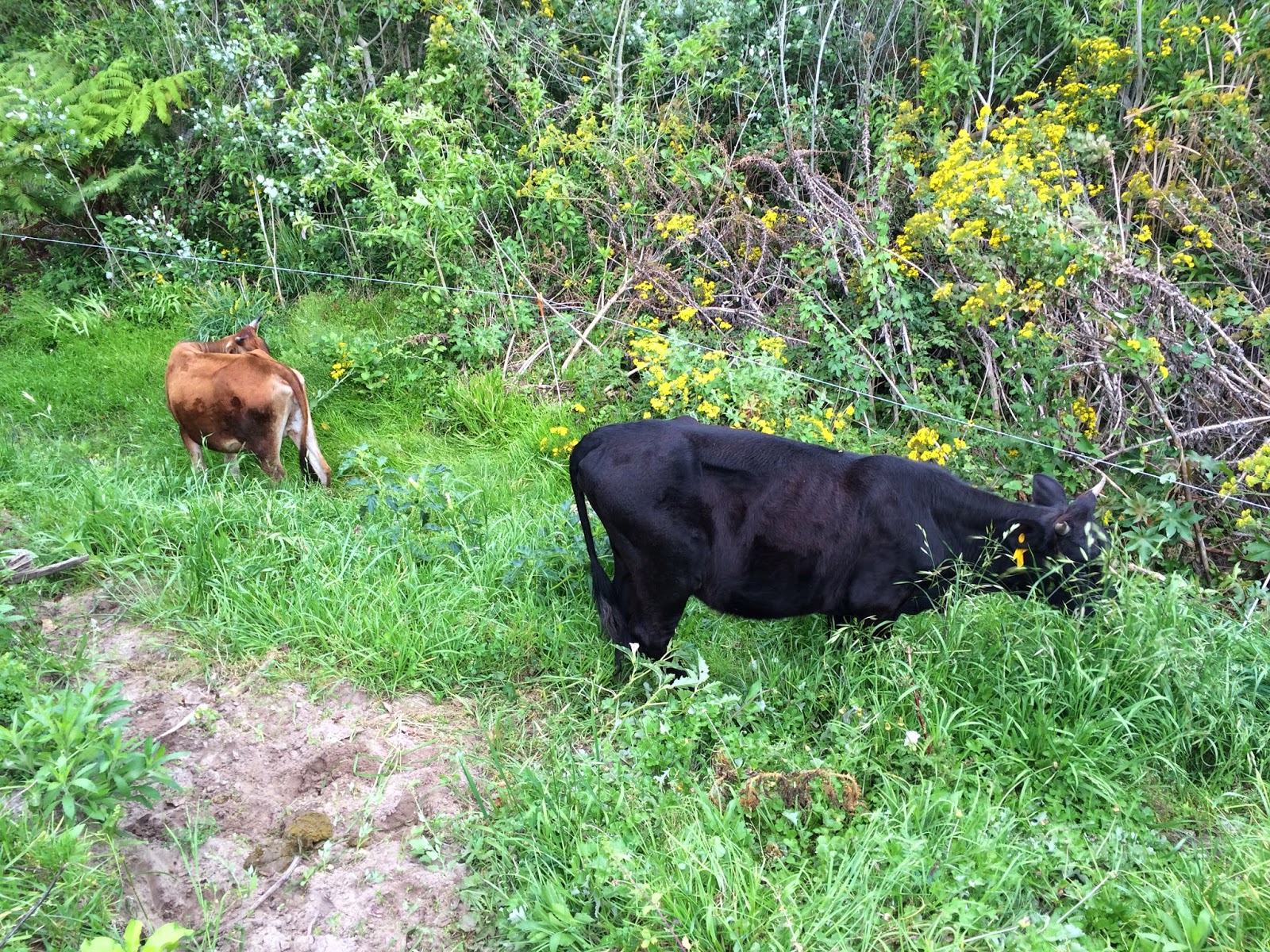
I have not spoken much about the cattle since I lost the calves and the bull. But is actually going quite well now with the two heifers. A brown one and a black one. We move them to new pasture everyday with the portable electric fence.

watch this video

We keep the “camp” small enough to ensure that they graze everything down (not just the tasty stuff). Cattle are picky eaters, they will first go for the greenest grass and then try the other stuff if they have to. So by keeping the camp just the right size I can ensure that they get enough, but that they don’t just pick and choose the best grazing. The important part of this strategy is that all the unpalatable stuff gets eaten as well, making space for other species to come through. The exercise is really all about building the soil. The cattle improve the soil in three important ways:

  1. They leave there manure behind – adding the nitrogen that’s crucial to get life going in the soil
  2. When grass is grazed, it automatically cuts off the proportionate amount of roots underground (thus adding much needed carbon to the soil)
  3. The animals hooves disturb the soil surface helping seeds get a chance to germinate.
Overgrazing is of course an incredibly destructive force, but in the a managed environment, grazing animals can build the soil and save the planet. (life is not possible without topsoil – just think about it)
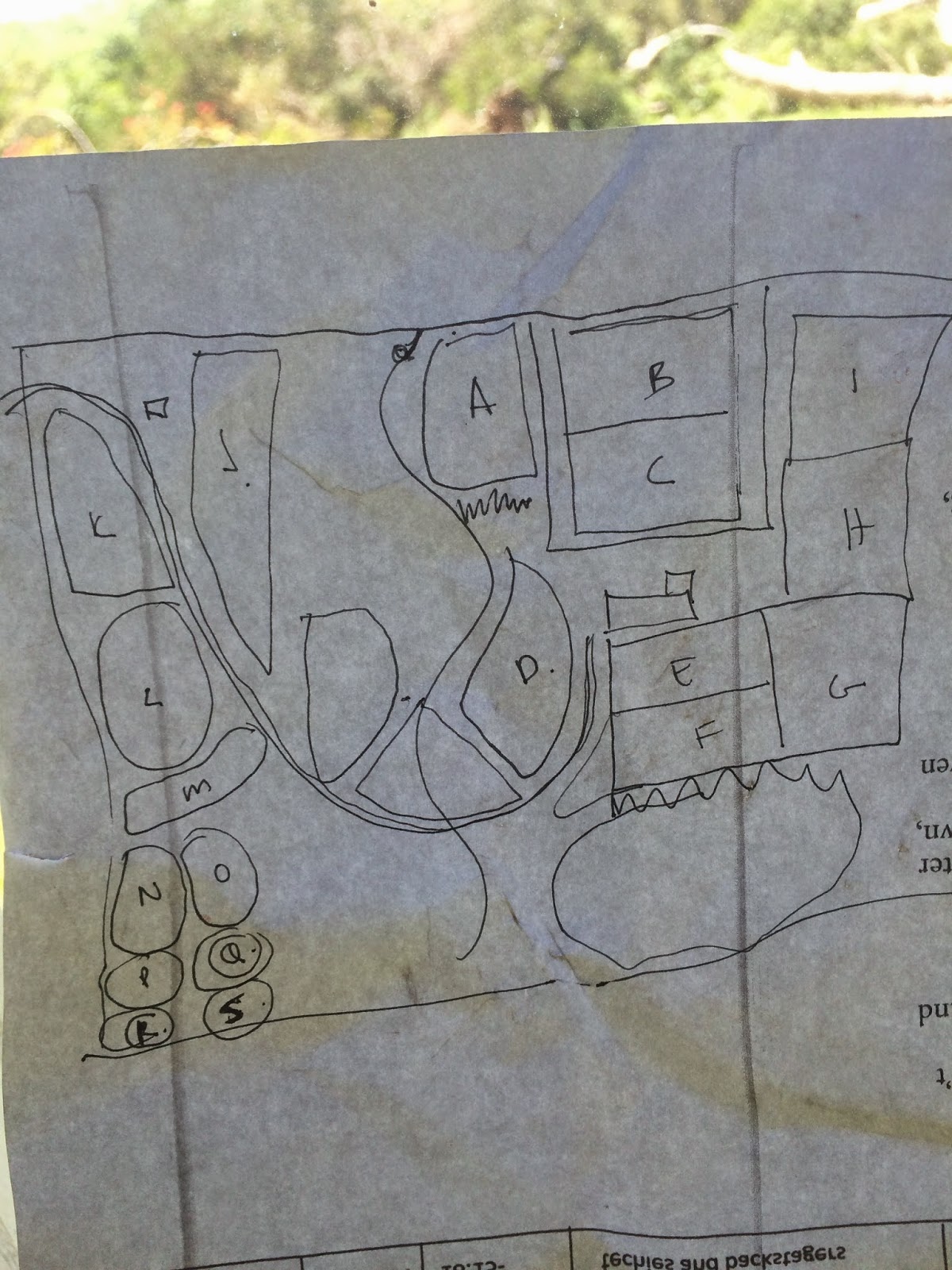
So how it practically works though the week, it that Mandoza (my trusted assistant) moves the cattle to new grazing every day. I prefer to move them in the afternoon when the sugar content of the grass is higher. I have a simple diagram which I leave in the cottage so Mandoza and I can refer to camps by alphabetical letter. We talk mainly by texting through the day. I charge the battery  for the electric fence here at home and once or twice a week I would make sure a newly charged better is taken to the farm. If we use this configuration we have 20 camps. so that would mean that would mean that each camp would get 20 days rest if each camp were grazed for one day. Of course depending on rain and time of the year, 20 days may or may not be enough time for the grazing to recover, so the idea would be to vary the size of the camp accordingly. I can see now that we have had some rain and the days are warmer, the grass is looking good and I can keep the size of the camp quite small, giving me perhaps 30 or 40 camps in total. The grazing is looking quite healthy, If I compare it to my neighbour’s place where he has sheep, cattle and goats continuously grazing the grass down to about 50 mm high, then we are looking very good.
I am also slowly, but surely expanding the pasture. Over the weekends I spend time with the chainsaw cutting out the alien invasive species: Black Wattle, Port Jackson, Inkberry, Blugum, Poplar and Cape Wattle. I start buy cutting paths just wide enough to run the electric fence in. I create a camp in a forested portion. The cattle eat some and stomp down other parts including brambles and vines making it easier for me to come in with the chainsaw. I find it does not take long for the grass to begin to establish in areas where I have opened up the ground to new light that was previously blocked by tree cover. Anyhow, I enjoy working with the cattle. I see them as my landscaping assisants. We work together to bring this farm to be the most that is can be,

Making way for something better.

The thing is, I have refused to accept that my life would become ordinary. I have refused to accept that I would be satisfied with a 40 hour work week and a pay check. I have refused to accept that I would be satisfied with a life that requires me to focus for its duration one specific discipline, one specific focus, one specific profession. But this has caused me some pain and some confusion and some clutter. I can see how, in my defiance I have taken on more and more projects and responsibilities. The assumption in the back of my mind being that I am some kind of superman that has no limit to my ability to take on new stuff. But now, for the last few months at least I have begun with a campaign of cutting down. Taking on the farm has made me realise, number one, that this is what I really want to get right. If turning the farm into a healthy, vibrant and productive family place (perhaps like it may have been many many years before) is the one thing I achieve in my life, then I will consider that a life well spent.

Or at least this is what is running through my head as I dismantle the Hothouse that I built in 2011 to house my aquaponics pilot project. At the time I had expected it only to last a year or two so the time is right for it to go. The real pressure for it to go has of course come from my children and from my wife. They would like things to look a little neater in the backyard. I can resist. I can be forceful, but that would also not be right. So down comes the hothouse.

I had built the entire structure from scrap timber. Timber that I bought from a scrap dealer, called DIY Timber but scrap nonetheless.

I put everything together with my Ryobi Hand held electric screwdriver / drill, so taking it apart gain, involved me unscrewing the boards and the brackets. This allowed me to save most of the timber which I have now taken to the farm. I will probably use it for a new hen house project I have in mind. I must say though, that I learned a lot from taking down the hothouse. I could see what worked and what did not. The plyboard that I used to form the circular from were not a good idea. They did not hold their shape. The tunnel plastic was great. It did begin to rip but only in the top point which had a poor detail that was too sharp. I learned from this hothouse in order to be in anyway warm in the winter months, every minute of sunlight must be captured. All shadows must be avoided, and by the same token, things can get very hot in mid summer, not for the Tilapia, they love worm water, but for some of the plant species, so some way to ventilate is critical.

The timber has generally held up very well over the last three years, but where it has been in touch with moisture, either in direct contact with the soil or where tanks or filters cause continuous moisture, the timber has begun to show signs of rot.

By taking this structure down I now make it possible to build a better one. One that is an improvement on the first one. I would not be able to build a better one if the old one is still there, or it is unlikely, because some of the components need to be re-used and because it just never becomes a priority above the other items on the to do list. But what other parts of my life and my schedule have become old and tired and need to be taken down to make way for new possibilities?  Or am I extending the metaphor of the hothouse to where it does not belong. Are there some parts of the the way I do business, the way I practice as an architect, the way I invest my money, the way I spend my time, that can be dismantled, pulled apart to make way for something better. Maybe and I can see that is what I have been doing in the last while. Cutting down slowly. realising that I am human and can only do so much in a given day and in doing this maybe, just maybe, I am making way for something better.

Two dead Chickens

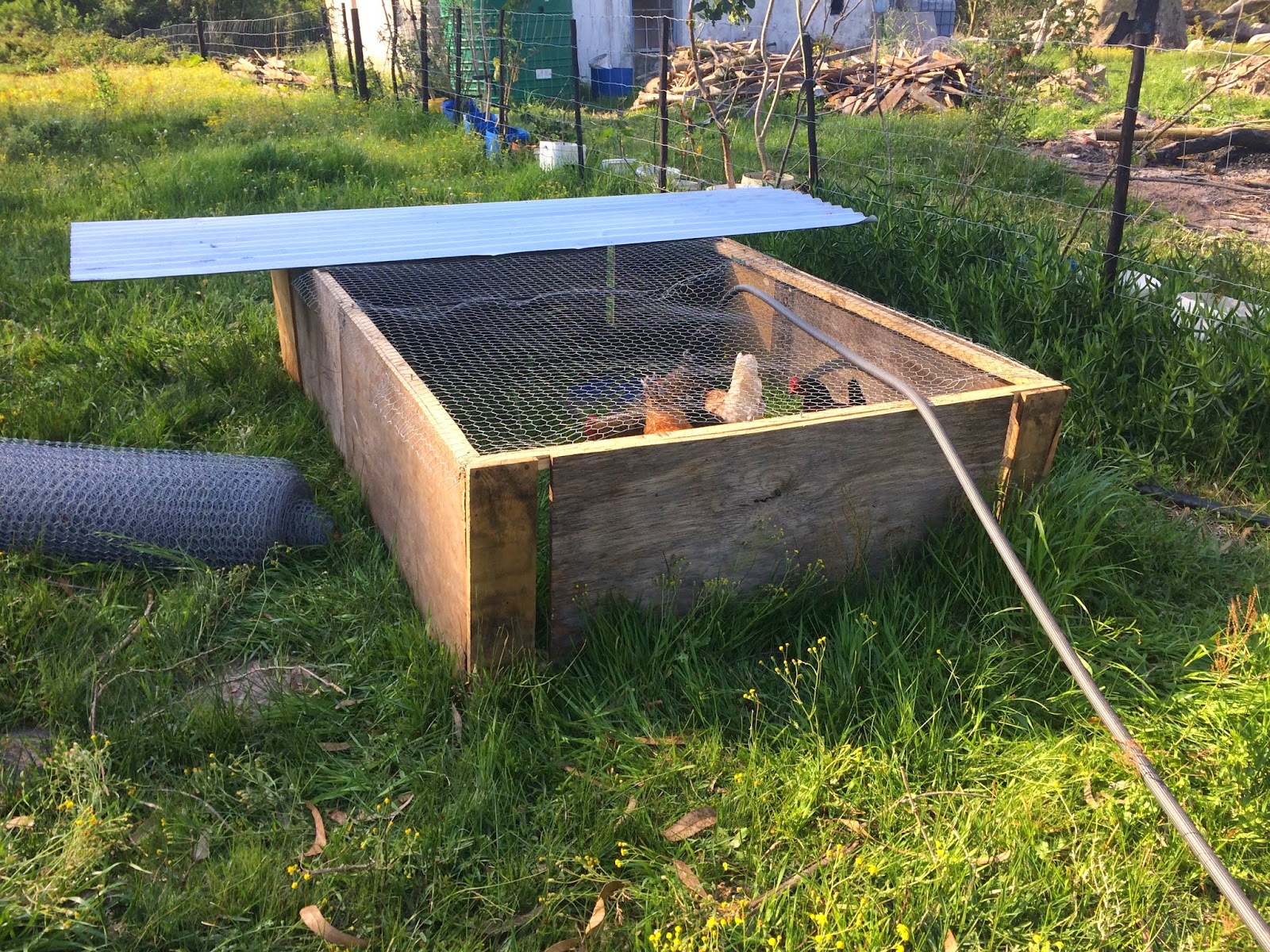
Its not that I expected it to happen, but I am not surprised. Two chickens were taken last night, probably something as small as a mongoose. It must have slipped under the frame of the chicken tractor. We have re-enforced the pen now, by adding a trim of chicken wire that I believe a mongoose may not be clever enough to dig under.

I suppose the other way to have gone about this would have been to have built an absolutely impenetrable concrete and brickwork fortress for the chickens. Something that would have taken a year and something that could withstand any attack including hurricane and leopard. But I don’t think that’s the approach that I care to take. What I am trying to get right at the farm is efficiency in design. The question I continuously ask myself is: What is the appropriate response?

I suppose this is what I am trying to get right in my life. Because I can be cautious but it may stop me ever setting a foot out the door. Or I could be reckless and risk hurting those that depend on me. Too much caution is bad. Too much recklessness it bad. But what I am doing with the chickens and what I am doing on the farm generally, is observing. Taking and action and observing the response of the farm.

Through the action of introducing the chicken tractor, I have been able to observe that I have a mongoose challenge. I can now prepare a measured, sensible response to the mongoose challenge. I can respond with design. The kind of design that does not destroy habitat. The kind of design that is the gentlest possible intervention to address the challenge.

Do you see how this is different to the approach of conventional agriculture, conventional medicine or conventional city building.? In conventional agriculture where we find we have insect challenge we introduce insecticides and destroy all insects, good bad or indifferent. We do not take the time to observe and develop a measured response. In medicine we respond to microbial infections with antibiotics. We do not take the time to observe. We annihilate all bacteria, good bad or indifferent. In city building we act against variety, where one noisy business upsets one complaining resident, we abolish all mixed use suburbs and replace them with a monoculture of residential, a monoculture of offices and a monoculture of factories. We act in this way perhaps because we are afraid of things going wrong. We are afraid to make mistakes. We are afraid perhaps of the ridicule or the mockery, So we become cautious. We make very safe decisions that cant possibly go wrong. We get life cover, medial aid and short term insurance. We get cars with a “motor plan”.We get safe jobs that promise a pension to look after us so we don’t embarrass ourselves by being a burden by making the mistake of running out of money before we die.

But of course in all this cautiousness our dreams are postponed and the richness of what could have been our lives becomes displaced with a life of slavery to those that offer the promise of comfort and security. This life my friends, is not for me. And yes there will be some blood and guts along this path.

But this is the path that I am committed to walk.

Moving the Chickens

I am not entirely sure that I am ready to move the chickens to the farm, but its done, I moved them today on the back of a hired trailer, with a whole lot of potted trees from my hothouse which I am busy dismantling. All but the one hen that is broody and sitting on eggs.

I am sure I could have built a  better shelter for them. In fact I have a much better one planned, drawings and everything, but like with so much in my life, this is what I am able to do now, with the time and resource that I have. I console myself by saying it is a temporary solution. But I say this as I look around my study on the Sunday evening with all many of the temporary shelves, piles of books, heaps of tools un-carpeted floors and skew hung posters, which were all “temporary ” solutions.

How much too in my business is the result of pragmatic thinking. “This is the best that we can do, let it out the door, or run the risk of missing the deadline”.* But is it not in this way that my life becomes a sequence of compromises.  Is it not in this way that I miss on the opportunity to do great work, lovely chicken sheds, great articles, beautiful buildings? But perhaps its better this way. Rather a life of compromises than a life of waiting for the time to be right. Waiting for the movement to strike. But never taking action, Never doing stuff, because the circumstance is just not right.  I don’t know!

But I do know that we have 5 fowl in the new pen. One hen got out when I was moving them out of the transport cage. I hope we can somehow get it back. I will ask Mandoza if he can think of a way to catch it tomorrow. The danger of course is that unknown predators roaming the farm kill all the chickens tonight. I have not yet taken the time to make the shelter “dig under proof”.

I will keep you posted. Lets see how it goes tonight.

* In a way too, this blog is a battle between getting something out and getting something right. I would like the blog to have more meaningful articles. I would like there to be thorough videos explaining some of the things we do. I would like the photograph to be of better quality. But I suppose if I waited for all those things to happen, I would never put a blog out at all!

update – 8 9 14

Chickens all still alive this morning and I managed to catch the one that got out. (I popped into the farm on the way back from a meeting nearby.

update 11 9 14

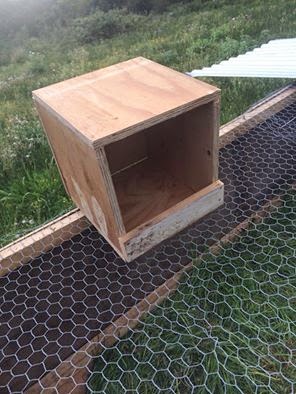
Added a nest box this afternoon.

A simple design of 300 X 300 boards cut from a 19 mm Shutterboard sheet. A little plank across the front to keep the eggs and nesting material in. Then simply screwed into the side wall of the Chicken Tractor.

The chickens seem happy. The peck at the grass all the time and scratch in it. Mandoza is moving them to new grass every day. So far so good. No predator attacks. I put a bunch of Bluegum leaves in for them to nest in. I heard somewhere that Bluegum leaves are some sort of natural bug repellent.

We’ll see!

A Place of Power

I have been cleaning up the yard a bit at home. I suppose now that we have the farm, I have little excuse left for turning our sub-urban backyard into an ongoing agricultural experiment. We have veggies, fruit trees, grape vines, Tilapia, a duckweed pond and a chicken run. I am under pressure to move the chickens, the grape vine, the tree nursery and the Tilapia hot house out of the back yard and on to the farm.

But its kind of sad. I know I am making space for bigger and better things, but I still have a vision for this backyard, that will now remain unfulfilled. I would have like to have completely taken out the lawn and replaces it with a tree nursery or chicken forage. I would like to have drained the pool, roofed it into a Tilapia aquaponic garden hothouse. I would have liked to have gone further with rainwater harvesting, composting and grey water systems.

But in clearing out the yard, I am also taking stock. I am clearing out the rubbish that has accumulated. Burning those short bits of timber I thought I would use here and there. Its funny, its almost as if all this stuff grows to have some power over me. And as I burn it I feel the power return to me. Too much stuff! That’s the real problem. We get more and more of it and it begins to mess with our minds. It begins to take my personal power.

I am not sure that I know what I mean by “personal power”, but I have come to see that inside me there is a personal energy or “power”. Some days it is stronger, some days it is weaker. I can feel it change sometimes. If, maybe somebody close to me says something hurtful. I feel my power diminish. If I am doing physical work, I may feel tired, as if though I cannot go on. And piles and piles of disorganised stuff has a similar effect on the energy. This “power”. It makes me feel weak and discouraged.

This realisation is behind my drive to simplify, to live with less. I can see that living with less will give me greater vitality and greater strength. I have go no idea why, of course. But, the mechanics of this phenomenon are not as important to me as the absolute knowledge, that for me, in my life, the less clutter there is, the less noise there is, the less stuff there is, the stronger I feel. And, what’s more, I notice that its like some sort of spiral effect, because the stronger I feel, the more I am able to do to rid myself of those things that are making me feel weak, so I, in turn become stronger again.

My quest , and I suppose, many of yours to, is to find my strongest self, my fullest self. All else flows from there. My ability to love and give. My ability to lead and contribute, all of these are by products of a strong self.

So, as I step back into the work week tomorrow, let me remember the feeling of power and strength I hold today. Let me carry it with me to the meetings, in the proposal and the reports. Let me remember that the place from where I come is a place of power.

Some Perspective

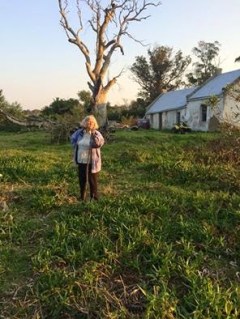
I went out to the farm with my mother on Sunday. She helped me identify some of the trees that I don’t yet know. But also by her just being there with me it helped me gain some “lifetime perspective”.

My Mom

A perspective that helps me see that its OK if things take the time that they need to take. Its going to take a lifetime sculpting this land, this giant garden. The task will never end. My learning, I am sure will never end. I see this time now as just the beginning of the relationship. The “getting to know each other” stage.

I wish I could tell you more about what has been done, since last I checked in, but to be honest, I have been really busy in business. I have been toiling, mostly mindless toiling, the kind that I just have to do to keep afloat. The kind of toil that makes me wonder if there is a different way, a simpler way, perhaps a more beautiful way for me to live out my life. A direct way. A way that cuts straight to the chase. A way that does not see everything as a means to and end. A way that is the end in itself. 

I spend so much of my time doing stuff, not that I want to do, but what I am required to do in order to achieve an objective and so much of the time even the objective that I am trying to achieve is not actually what I want but rather just something that helps me achieve another objective which is not what I want but helps me achieve the next objective. Yes I can see the insanity in this cycle and you can see the insanity in your own life, but just because I know the question does not mean I have the answer. I can see the treadmill that I am on, but that does not mean I know how to get off. And without wanting to push the metaphor too far, I can see that it really is possible to fall quite hard once you realise you are on a treadmill and look around, take your eye off where it should be and loose a footing, tumbling face forward and head over heals.

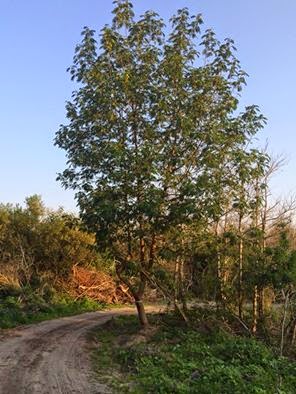
I tried not to think of these matters while I was out in the forest with the trees and my mom, where we found a tree that I very much hope is indigenous, but looks very much like

What tree is this?

the Australian invasive Acacia Mearnsii (known here as Black Wattle). As far as I can see its an Acacia Caffra, but some of my clever friends think is could be Peltophorum Africana. 

Its not that I have a facination with latin sounding names or the classification of each plant and tree, but rather just that I would like to know if they should be chopped down or not. If they are invasive, then they are just going to cause me more work over the years as I have to keep them out of areas I don’t want them to be in.So if anyone reading this blog can identify this tree or perhaps knows a internet group or forum that is likely to be able to, please let me know.

My mission in the next few weeks is to get going with planting potted trees that I have been moving from my house in Walmer. My mom tells me its late I should have planted in autumn already. Here I was holding on until spring, but I will plant anyway. 

The other project that is becoming urgent, is for me to move the chickens to the farm. Two of the chickens have turned out to be roosters and have taken to crowing early in the morning, I am sure upsetting the same neighbours who complained last time I had a rooster. So watch this space for chicken coop progress.

The Mystree tree