
Pebblespring farm appeared on national TV on Sunday night. You can watch by clicking in this link:
Category: All Posts
Tao of the farm – Principle number 26: “If you want to eat lamb you must be prepared to see blood.”
(this episode in our lives was also the subject of a short TV documentary)
December last year was the first time that I have slaughtered a goat. I have killed chickens and fish. I have even shot antelope from the comfortable distance of a rifle’s range, but to get up close and personal with a warm blooded, living breathing mammal is a whole different thing. I don’t enjoy killing. I am sure there are very few mentally balanced people that do. I have however come to see that I am an omnivore, and that my family before me for hundreds of thousands of years (probably longer) have eaten meat as part of their varied diet. Every time I look at my dogs, they are to me a living, breathing reminder of how their species and mine have walked a long way together and have formed each other and shaped what we have become. Someone told me once that humans
 |
| The Ibhoma Under Construction |
domesticated dogs 20000 years ago, while we were all hunter gatherers. (even before we invented agriculture). After the dog, we apparently took another 10 000 years before we thought of domesticating the next animal: the cow. The point being, that despite recent popular tendencies toward vegetarianism, eating meat and dealing with the animals that provide it, has been part of our ancestor’s routine for a very long time. It is within this perspective, that I came to say to myself, if I am going to eat meat; I must have the courage to kill. It is always easy to avoid doing the killing myself. The supermarket, the restaurant and the fast-food outlet, make it easy. Together they conspire to make eating meat a light thing.
But the story of how I came to slaughter this goat requires a little explaining. You see, my son Litha, at the age of 18, decided to follow in the tradition of his mother’s ancestors and to become circumcised in the 1000 year old Xhosa tradition. The tradition, I am sure has evolved and grown over the years, but in its current form in our region, it involves a 3 week retreat, which begins on the day of the circumcision. Litha’s retreat was on our farm, where he lived in an Ibhoma, a rough made shelter his brother, cousins and uncles put together for him the week before. The location was secret and not visible from any road, house or public thoroughfare. In that time in the bush Litha had no clothing (he had to make do with a rough woollen blanket); he had no electricity, running water, TV, cell phone or contact with the outside world. A great privilege in fact and the kind of retreat I would encourage every young man to go through.
 |
| We have co-evolved with dogs |
In the Xhosa tradition, male circumcision is a rite of passage. You go into the bush a “boy” and you come out a “man”. The boy literally leaves his childhood behind, with all his boyhood possessions burnt in the bush on the day that he leaves. The new man leaves the bush stony faced, not permitted to look back at his boyhood in flames behind him. Of course on the day that Litha returned home, there was a massive feast called an Umgidi. There was a lot of meat (and booze) at this celebration, but none of it involved me having to draw blood myself. We had professional butchers deal with all of that.
The goat, that is the subject of this story met his end two weeks before the great homecoming as part of a small celebration in the bush called Omojiso, or literally “roasting of meat”. This function signifies a milestone in the stay in the bush where the Umncibi (traditional surgeon) is happy enough with the healing process to permit the boy to come off the very strictly limited diet of the first week after the procedure. Kind of like “nil per mouth” the hospitals enforce with certain critical cases in their care.
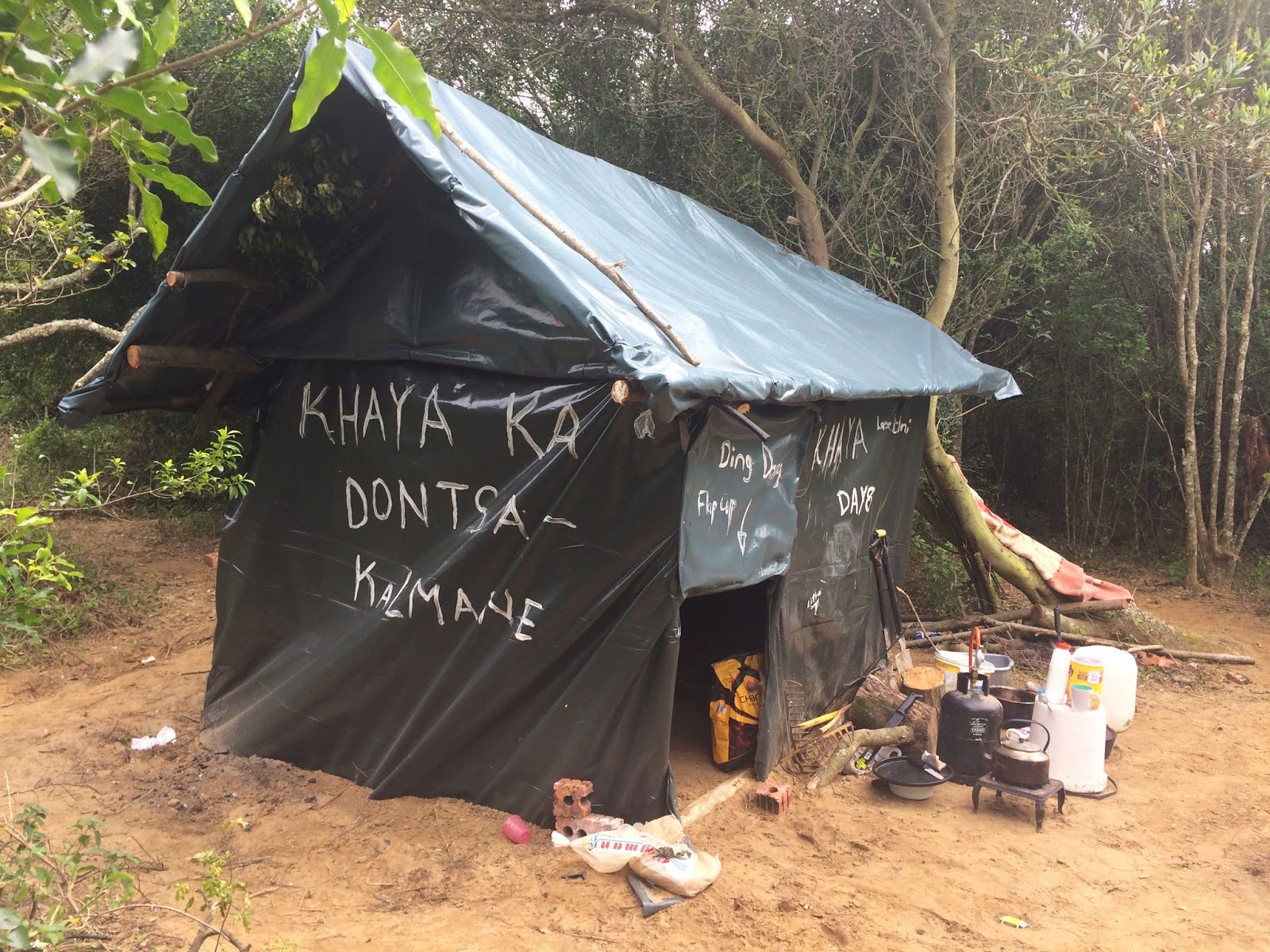 |
| Its surprising how little we actually need to survive |
Going into this complex and meandering process, I had made a very conscious decision. I am not a Xhosa man I do not pretend to be a Xhosa man. I quite respectfully have no interest in becoming a Xhosa man. I am interested though, in do what I need to do to facilitate my two sons’ becoming Xhosa men, if that is their choice. So it transpired that I found myself in the curious situation in the bush, at Pebblespring Farm, officiating over a Xhosa function called Omojiso.
Tradition requires that a goat be slaughtered to mark this occasion. While I could very easily have passed the task of killing the animal onto anyone of the junior Xhosa men assembled there on that day. I opted rather to show my full participation in Litha’s chosen path by taking the animal’s life myself. We had bought the goat two days before from a farmer about and hours’ drive from us. It was a beautiful young brown male goat. I chose the goat myself out of the herd that was corralled for the purpose of being chosen by people like me, for events like the one we required a goat for. I had no hesitation in pointing out this young brown male when the farmer asked me to choose. We secured the goat by its horns at the end of a long rope in the middle of a bush pasture and there the goat spent its last days and hours peacefully foraging, sleeping and generally dong what goats do. In the morning of the Omojiso, the speeches and introductions went quite quickly and soon came the time I had been anxiously dreading. The goat was held down by two other men, I drew then knife I had sharpened carefully the night before. I cut first through the windpipe with the sound of the air escaping surprised me, then further into the neck striking the arteries releasing the blood to flow. There was still life in the body, as an older man showed me to cut deep in between the neck vertebrae severing the spinal cord till the body lay limp losing the last of its blood. I felt relieved that it was over. I felt the heaviness of taking this life. I felt good that I had able to play my role as a father and physically and demonstrably support my son in a path that he had chosen to walk.
 |
| All in the family |
The goat was cooked there and then in pots that had been placed on the fire for this purpose. Litha was able to eat the meat he had been looking forward to after a week of bland dry rations. The two weeks after the Omojiso went quickly. Litha healed well and return triumphant two weeks later to jubilant groups of friends and family. Litha I am sure learned many lessons in the bush, but I too came away a wiser man. I learned about the heaviness that comes with supporting my children and those I love in pursuits that cause me to fear for their safety. I learned that my son is a surprisingly strong a resilient man. I learned what it means to kill a goat.
I know it is an obvious fact and that everybody knows that to eat meat, an animal must die. But sometime you need to wield the knife yourself and feel the warm blood on your skin for it to sink in. What other blood do we have on our hands? What is the price that must be paid to run electricity through all of our homes, heating our bathwater and lighting up out plasma screens? At what price to the carbon levels in the atmosphere? At what price to we commute to work every day, causing oilfields to be drilled or deserts to be fracked and wars do be waged? At what price do we employ domestic workers at near slave wages? What of their children, what of their families, their hopes and their dreams? The bread that you eat from barren wheat field of toxic monocultures that spread over the horizon on every direction in the Western Cape and Freestate; where before active soils, and communities of plans and animals supported stable ecosystems that remained in balance for thousands of years? There is a lot of blood out there and there are very few of us that have hands that are not stained by it.
 |
| The goat sees its end |
So I encourage you, wherever you can, whenever you can, to get as close to the brutal truth of your lifestyle as you can. Do this as a test to see if it is not too heavy for you to carry. Because no matter how you try, no matter how modern urban living tries to shield you, you cannot escape the Law of the Farm number 26: “ If you want to eat lamb, you must be prepared to see blood”.
Tao of the Farm – Principle number 4: “You are not the first person to plant a lemon tree”
Hlubi and I this weekend visited “Babylonstoren, a beautiful wine farm somewhere between Paarl and Stellenbosch. It has beautiful vineyards and fine examples of historic Cape Dutch architecture, but more than anything else, it is the gardens that leave a lasting impression. The three hectare garden is expansive and is set out as a long rectilinear grid and irrigated with a water channel that runs along is length down the gently slope.
 |
| Annuals and Perennials, Fruit, vegetables and Herbs |
The gravel pathways form blocks which frame different zones of fruits, vegetables, poultry, herbs and flowers. It is a beautiful place, but at the same time is a fully functional, productive garden producing the highest quality produce for the three restaurants and shop on the site. The gardener is highly knowledgeable, as have been the gardeners that took care of gardens just like Babylonstonern in the cape since the time on the Company Gardens in Cape Town in the 1600s. The point of course is that gardening is not something new. People have been perfecting this art for thousands of years. Each generation of gardeners has worked to make slight improvements and modifications to the work of the previous generation. No successful gardener has ever plunged themselves into an open field armed with only muscles and a spade. Of course effort is the key ingredient. But in as much as Law of the Farm Number 3 is true when it says that reading about sheep does not make you a shepherd, it is also true that there is a huge volume of information available to be passed on about any conceivable subject, including becoming a shepherd and including planting a garden.
 |
| The central gravel access path |
At Pebblespring Farm, I have planted one or two lemon trees, but I simply don’t have 10 years to wait to see if this particular variety grows well in the particular spot I have chosen for it, with its particular soil and moisture characteristics. To short cut this process, I talk to other gardeners, I read books, I Google, I travel to Cape Town and visit places like Babylonstoren. Why? Because its all been done before and if I am thorough in my research, I will be sure to able to take advantage of the learning hundreds, perhaps thousands of years of lemon tree planters across the world. By playing my cards right I can obtain the power and clarity that would otherwise only be available to me if I had lived for many generations.
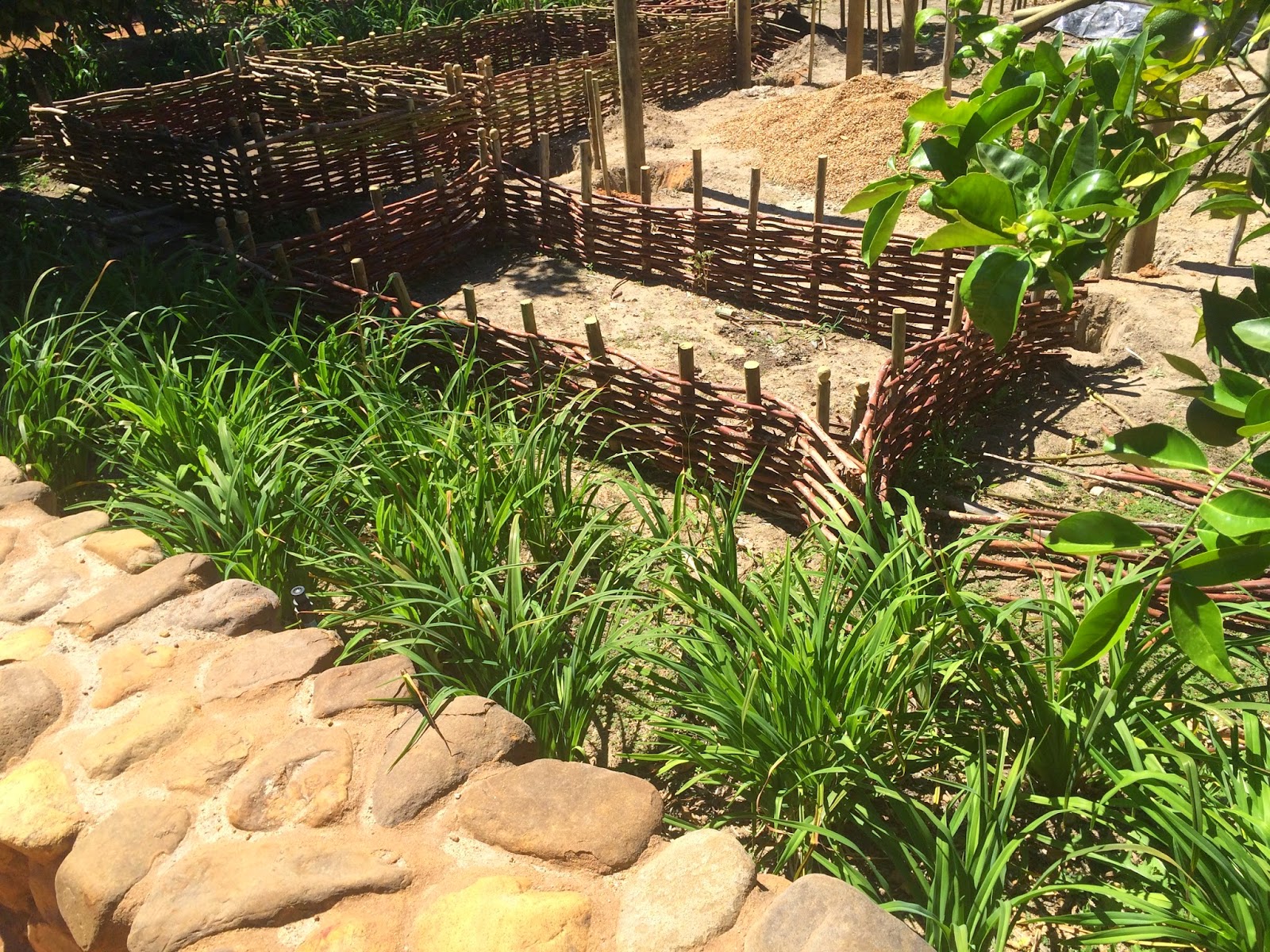 |
| An abundance of texture and colour |
This is of course true whether I am interested in planting lemon trees, learning the art of Kung Fu or the craft of knitting a jersey. Invariably what we are trying to do has already been done, and if we look hard enough we are able to find the stories of those that have done it. I have seen though in my own life, that finding the information is not difficult. What is often difficult for me is that, faced with the huge quantity of available information, the process of trying to consume it becomes all consuming. The balance between research and action becomes distorted and I end up binging on information: books, movies, travel, blogs tweets and Facebook pages. In the same way perhaps as the obese load up with so much energy giving food that they eventually become so heavy that they are not able to move to use up the energy, causing them to become immobile and to the point where the only action they are capable of is to take in more food.
My view then is that we must rather be led by action than be led by research. Let us push forward with our mission to the point where we can see that we can no longer advance because of our lack of knowledge. We will know when we have reached this point because a question will begin to formulate in our mind. We will start digging the hole for the lemon tree, and a question will begin to formulate. “How deep should this hole be?” Once we know the question, it’s quite easy for us to know where to look and to find the answer. The research then directs our next action. We dig the hole to the required depth only to be faced with the question of soil preparation. Should we fill the hole with compost, or should it be manure? Do we need to increase the acidity; do we need to make it more alkaline? As we proceed in our action, we are prompted in research. The research then prompts us into further action. It sounds obvious I know, but actually what I am suggesting is completely in contradiction to our contemporary education system which at very least creates the impression in people’s minds that education and training is what happens in that part of your life before you start working. So, we” frontend” twelve or seventeen years of schooling into a young life at an age where working is frowned upon and even illegal. Once this stage is over, we enter our working lives where research is most often seen as a diversion or a destructive waste of time to the point where Google may be disabled on your company PC.
But don’t worry about all of that. Rather you just be sure that:
· Number one, you know your mission.
· Number two, you take the first step.
· Number three, you recognise when you are stuck,
· Number four, you find answers to the questions required to get you unstuck.
· Then proceed, re-check to be sure that you are still on mission and repeat steps one to four.
You can’t go wrong!
Tao of the farm – Principle number 24: “Some low life will steal you chainsaw.”
After this month’s livestock auction on Saturday morning, we stopped off at the farm on the way home. I noticed that the front door of the cottage, which is off its hinges for painting, was lying flat on the floor of the cottage. Normally it’s propped up in the door frame. It had been quite windy on Friday so, I dismissed it, but could not help to feel a little suspicious. I unlocked the store room, immediately looking for the chainsaw. I looked high and low scratching through boxes and unlikely places in some kind of denial and disbelief. It is nowhere to be found. Mandoza says he last used it on Thursday. He suspects the casual labourer that we employed the week before. A guy called “Sticks”

The door to the storeroom was not forced open, it had been opened with a key and the key had been returned to its normal hiding place. Mandoza thinks that Sticks may have seen the hiding place for the keys. Anyway, I am really upset. I am angry that we have thieves moving around on the farm, I am angry with myself for not being more vigilant with security and I am worried that I now have to find money to replace this piece of equipment that I really liked. In this soup of emotions that are now still floating through my brain as I write this on Monday morning in the coffee shop just up the road from my office. As I sit here in the smoky interior with the familiar seventies music soothing softly in the background, I struggle to remind myself of Law of the farm number 24: “Some low life will steal your chainsaw” Or as some American hippy once said “shit happens”. The mongoose will eat your hens, the bubbler in your Tilapia tank will fail, ticks will infest your cattle. These setbacks are constants. They will happen. The extent to which they happen and the degree of damage they cause may be variable, but they will happen. I try to console myself with the truth of this law. It helps a little, but maybe tomorrow I will be OK. Maybe tomorrow I will come to see that we have become softened by the illusion of comfort offered to us by our lives. Perhaps I will come to see that we are lead to believe that nothing can go wrong. Everything happens at the flick of a switch. Even here in South Africa, and especially if you are urban and middle-class, you may go through very long periods of time where nothing ever goes wrong. The bottle store never runs out of beer, the soccer is on the television every Saturday, the mall keeps it opening times as advertised and the lotto draw happens as scheduled every weekend. When things go wrong, they are small, they are temporary and we are shielded from the crisis, by layers of government and corporate structures. When the farmer’s potato crop is destroyed by a swarm of locusts, we somehow magically still get our Lays lightly salted from the all night convenience store. The massive corporate chain makes sure they import potatoes from some other part of the province or some other part of the world, we do not so much as notice a difference in crispness of our favourite snack.
Everything we consume is in this way filtered to be free of risk, to the extent that when our restaurant scrambled eggs aren’t exactly the correct degree of softness, we feel completely obliged and entitled to feel miserable and to throw a tantrum. What I am saying is that governments and corporations have very effectively come to create the illusion that rule of the farm number 24 does not exist. It does. Some low life will steal your chainsaw, and the sooner you (and I) wake up an begin to live and plan our lives according to this law, this non-negotiable constant, the sooner we can be more closely aligned with the way things work. Delusion may be comfortable, but making peace with the brutal truth brings us into closer union with the universe and its laws. And in this way we make ourselves free, not by selling ourselves into slavery to pay for the cost of the triple insurance premiums of comfort, safety and security.
Tao of the Farm – Principle number 17: “You can do it alone, but its better with family”
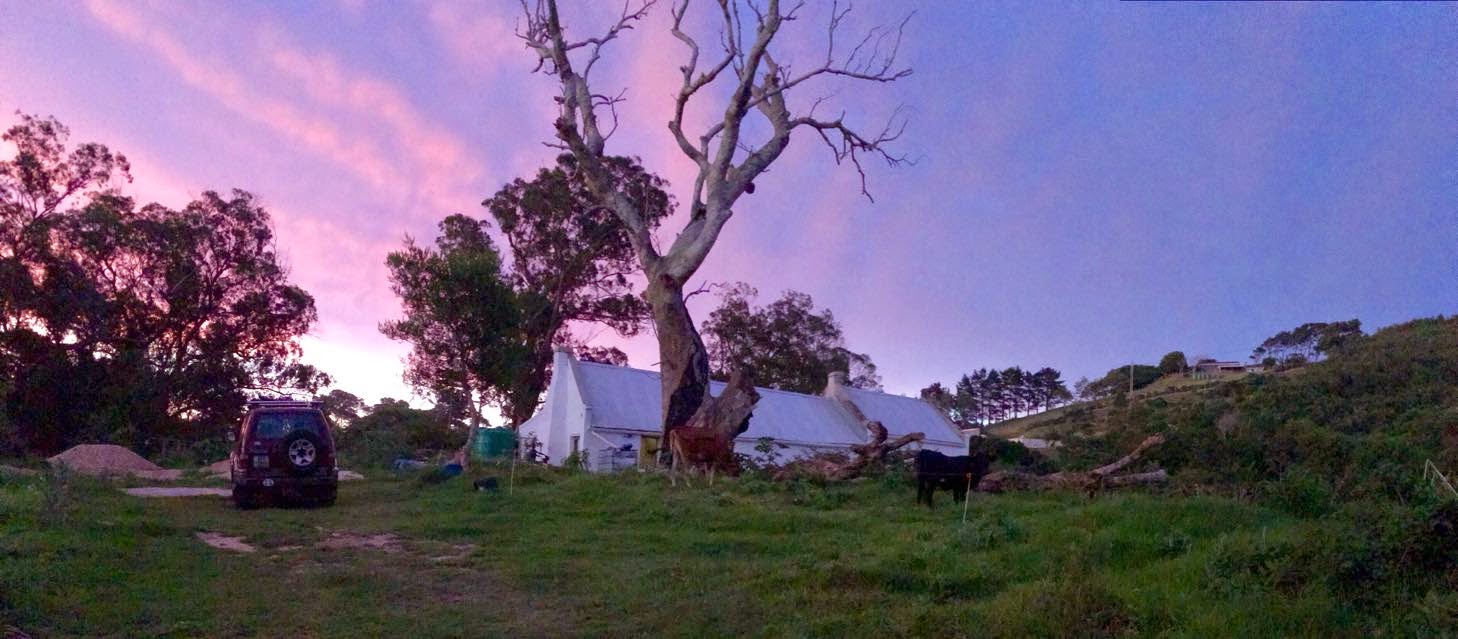
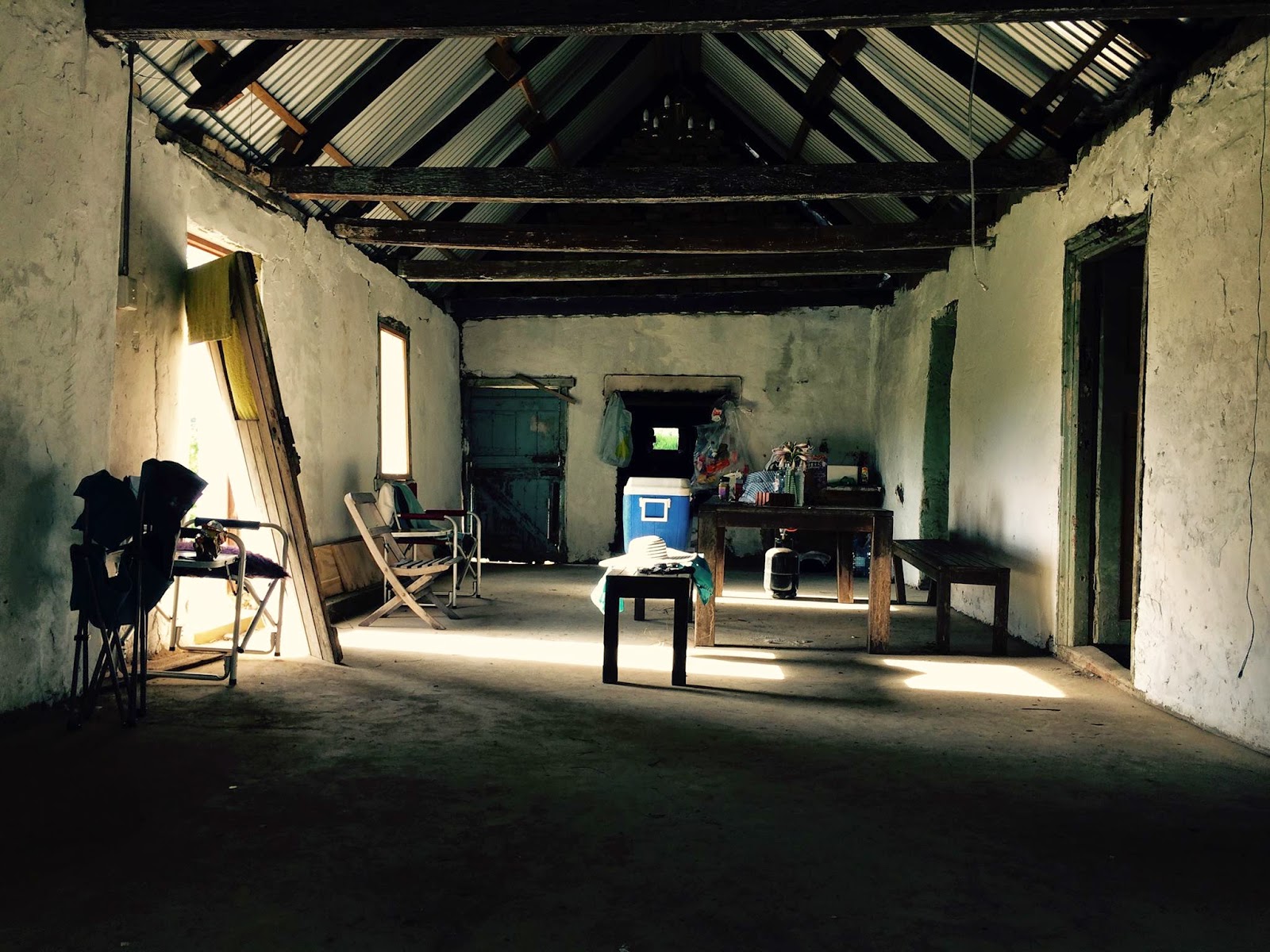
As I write this I am sitting at the table inside the “long room“ in the farm cottage It’s a warm summer Sunday afternoon and we have been here since lunch time yesterday. But what makes this weekend different is that my family is here with me. You see, the cottage has now been repaired to the point where it is now just about weather proof. (Depending on exactly where in the cottage you stand during a rain storm) The cottage also has running water, lights that switch on and off and toilet that flushes. (all off grid I am proud to say) These simple conveniences make it possible for my wife, my daughter, my sister in law and her son to stay over with me at the farm last night. It was the first time for my wife to sleep over here, so I count it as a bit of a milestone. The thing is though, it just feels better to me for me to be going about my chores, moving the cattle, feeding the chickens or watering the fruit trees with my wife and family here on the farm. Yes we had a fun braai outside last night and a pleasant breakfast this morning, but for the most part it’s just about knowing that we are here together, not necessarily that we are having deep, meaningful conversation or helping each other physically. When, as I have been doing for over a year now, I work on the farm over the weekends leaving my family at home in town, it feels different. It feels more rushed, strained perhaps. As if though a part of me feels that I am stealing time from them. I don’t know. I have not consciously recorded thinking that I am stealing time, it’s just that when we are here together allowing time to pass slowly together, it just feels so much better, It feels very right. It feels as if though it were meant to be. So perhaps this too is a lesson from the farm, one of the laws of the farm, that are true to the farm, but true also to our civilisation.
Let’s think about this a little. Because the idea of family and its “usefulness” seem in some parts of the world to have become caught up in politics of polarity , where the term “family values” have become used as a code to mean, conservative, male dominated and religious. I am not talking about that here. Rather what I am observing is and process of evolution, where our species has grown to become strong and prosperous by holding together in tight family groups. Other species have evolved in such a way so as to make them highly successful to live alone for the most part. On the farm here we often see bushbuck. Sometimes a big impressive grey black male, will reveal himself for a few seconds before bounding off into the forest. At other times the female will peer through the shrubs, smaller and brown. We have not yet seen them together. It seems bushbuck are quite successful at living apart from each other for most of the time. But the ducks that visit the dam, are always in a family group. Sometimes there are four of them together, other times just two. I have not yet seen a lone duck on the dam. Ducks seem to be family birds.
Of course, humans have big brains and an impressive amount of will power, we can chose to do many things that may go against our evolutionary programming. We would live completely by ourselves ad we have proven it. Every now and then there is some record broken of how some brave person has circumnavigated the globe single handed in a yacht, even smaller than the previous brave person who did so. Of course it’s possible. What I am working on though in my own life, is to observe in me, what are the “laws” what is my evolutionary programming? In order that I can embrace it and work with it. In order that I can understand when I feel down or lonely that it is probably that I am feeling removed from my family. And by contrast, perhaps the reason Or maybe one of the reasons) I am feeling right now that I am feeling energised and reconnected with farm and with my life and with my mission is that I feel I am together in this with my family. We are on a joint mission. We are working together. We work at different speeds and we need different things to make us comfortable and relaxed, but we are all on the same mission.
Are we there yet?
(this piece first appeared in The Herald on 24 December 2014)

Perhaps as you read this you have reached your holiday destination? You have sped along the freeways or braved the airport terminal. You are where you want to be. Because, it is at this time of the year when many of us try to be somewhere else. We try to be where we are not normally. At the first chance we get, when we are released by our bosses for a few days or when we get a little extra cash, we escape, we run away, we go somewhere else. “Why is this?”, I asked my wife as we sipped Australian wine and chomped Paraguayan peanuts on our air Malaysia flight to Buenos Aires some time back. Can it be that the physical and spatial reality that we have built for ourselves is so intolerable that the only thing that keeps us there is that we don’t have enough time or money to leave it behind? No, this can surely not be the case. But even when we look a little closer, even at those times of the year when we are not on holiday, still we find this intense drive to be in a different place. Driven by the idea that the different place is better. Our cities are living testimony to this obsession. Streets, roads, highways, overpasses, underpasses, airports, railway stations, IPTS lanes parking areas all built at huge expense and at massive cost to the environment to be sure that we can get as quickly as we can from where we are now to where we are not. Stopping along the way, is controlled, frowned upon or downright illegal depending where you are trying to get to. We see it also in the things we purchase and consume. It is not good enough to have ordinary butter, it must be Irish butter, our olive oil comes from Argentina, Portugal or Greece, our cars from Korea and our phones form China. The other day I bought spring onions imported from Kenya. I kid you not…Spring Onions! Are we discontented? Are we displeased with this place, our place and the things that come from our place? No, I don’t think so at all. But I do think, as individuals, we are weak, we are without centre, we are easily manipulated and easily swayed by institutions and corporations that will make money for themselves in exchange for our freedom and for our time.
How much of our tax money is used to fund roads, bridges, harbours and runways? How much of our monthly salary goes to paying for cars, petrol and repairs. How many bright minds in our economy go to working in the motor industry, petrol industry, tyre fitment centres, vehicle finance and vehicle insurance? All collaborating and conspiring to build the machines and the system that make it efficient and effortless to get you to be somewhere else. Imagine the extra cash we would have if we did not need to pay for all of this year in and year out. We are fortunate of course because we don’t have to imagine car free towns and cities, we can actually visit them and observe for ourselves (or rather just Google them and save the cost of the flight ticket). There are many, many examples of kind and caring societies that have managing the car and taking back the city’s streets. Quebec, Venice, Curitiba and Stone Town are beautiful examples of how this can be done in such a way that these places become a delight for residents and visitors. We don’t have to imagine cities that grow their own food we only need to look to the Urban Agriculture of Mumbai, New York and especially Havana where 90% of the city’s fresh produce come from local urban farms and gardens and where more than 200,000 Cubans work urban agriculture sector. We don’t have to imagine a city that provides more than 90% of its energy needs from renewable resources, we need only to look to Reykyavik in Iceland.
But my appeal is not only that we allow ourselves to imagine a city with fewer cars, less pollution and less imports, but also that we begin to imaging a city that we are happy to live in, happy to work in and happy to spend time in. My appeal is that we begin to imagine a city that attempts not to dream up new products that we can manufacture and ship across the ocean, but rather cities that make responsible use of their land, their water their sunlight and forests to feed themselves, cloth themselves and house themselves. Perhaps this requires a mind-set though in which we begin to understand that we are not casual observers of the cities and towns we live in, but rather that we are active participants, actively creating the shape and form of our cities by the way in which we allow our lives to play out in them and by the way in which we choose to spend our money in them. Or will we remain trapped in the idea that the solution will come from somewhere else, that our clothing will come from China, that our electricity from Eskom in Mpumalanga, our food by refrigerated truck from Cape Town and that the only way we could navigate our city is cars running on Saudi fuel.
But wait, I can’t be chatting for too long, I have got to get back to the all-important task of basting my Brazilian Christmas Turkey.
Snakes Alive!

Of course we have lots to fear in this life. There are so many ways in which we can get hurt, killed, robbed or betrayed. Everyday we are exposed to danger. Motorcars are viscous killers. Any home contains all kinds of ordinary looking things that can kill us if we are not careful. And I am not even talking about rat poison or pool acid, just ordinary stuff, which when taken in the wrong quantities can kill us, like vodka, or paracetamol or lying in a bath. But it is of course not logical or acceptable to live in fear of bathwater, electricity or a motor car just because it can, in certain circumstances, be deadly. It seems though that we discriminate differently between Urban dangers and rural dangers. Or so it seems this week with the excitement caused by the appearance of two (very small) snakes in our rainwater tank. I have builders working on site and they were terrified. It effected their work. Some in my family too, (I dont want to mention any names) are hinting at not ever returning to the farm that is loved by all of so much. Of course I as a husband and a father must make every effort to understand that not all of us are the same and that some and may have different loves and fears. I understand this. It is not good enough for me to explain that as we warm up into summer, the snakes will be on the move and we should be on the look out.
Anyway, the snakes turned out to be two Spotted Bush Snakes Philothamnus semivariegatus. (thanks to the people at snakesofsouthafrica for help with the identification) which are not poisonous at all. There are dangerous snakes on the farm, like the Puffaders that like to lie on a sunny path waiting to be stepped on. What I am trying to say though, is that we are confronted everyday with a strong bombardment of ideas of what is “normal” and what is not. We are told that “Normal” is to work in a cubicle, commute to work in a Toyota Corrola, and watch rugby on Saturdays. So it is with normal dangers that confront us every day in the city. Because they are “normal” we tolerate them. Even when they kill us, we continue to tolerate them. But snakes, scorpions and frogs are “abnormal” dangers and they are to be eradicated, chopped into little pieces, burned, poisoned and obliterated. Such is the logic of our time.
So, while I can see that all this, to keep the peace I have had to make a visible effort to do something about the snakes. So I have cleared all the longer grass around the house and reduced the number of places snakes can hide. And also very cleverly I have installed a very innovative anti snake device onto my watertank.
You can watch the video if you like.
So, How have the cows been?
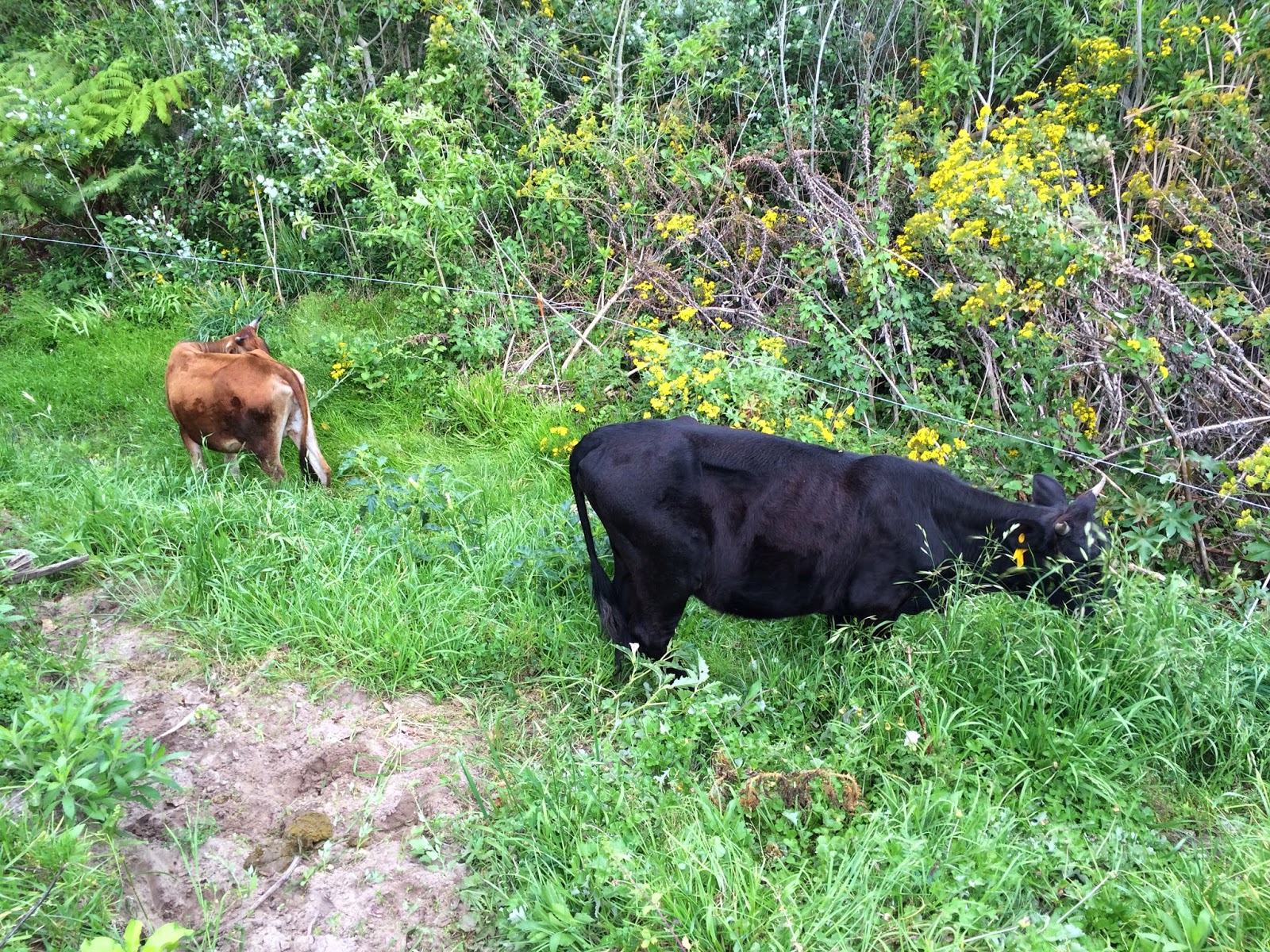
I have not spoken much about the cattle since I lost the calves and the bull. But is actually going quite well now with the two heifers. A brown one and a black one. We move them to new pasture everyday with the portable electric fence.
We keep the “camp” small enough to ensure that they graze everything down (not just the tasty stuff). Cattle are picky eaters, they will first go for the greenest grass and then try the other stuff if they have to. So by keeping the camp just the right size I can ensure that they get enough, but that they don’t just pick and choose the best grazing. The important part of this strategy is that all the unpalatable stuff gets eaten as well, making space for other species to come through. The exercise is really all about building the soil. The cattle improve the soil in three important ways:
- They leave there manure behind – adding the nitrogen that’s crucial to get life going in the soil
- When grass is grazed, it automatically cuts off the proportionate amount of roots underground (thus adding much needed carbon to the soil)
- The animals hooves disturb the soil surface helping seeds get a chance to germinate.
Overgrazing is of course an incredibly destructive force, but in the a managed environment, grazing animals can build the soil and save the planet. (life is not possible without topsoil – just think about it)
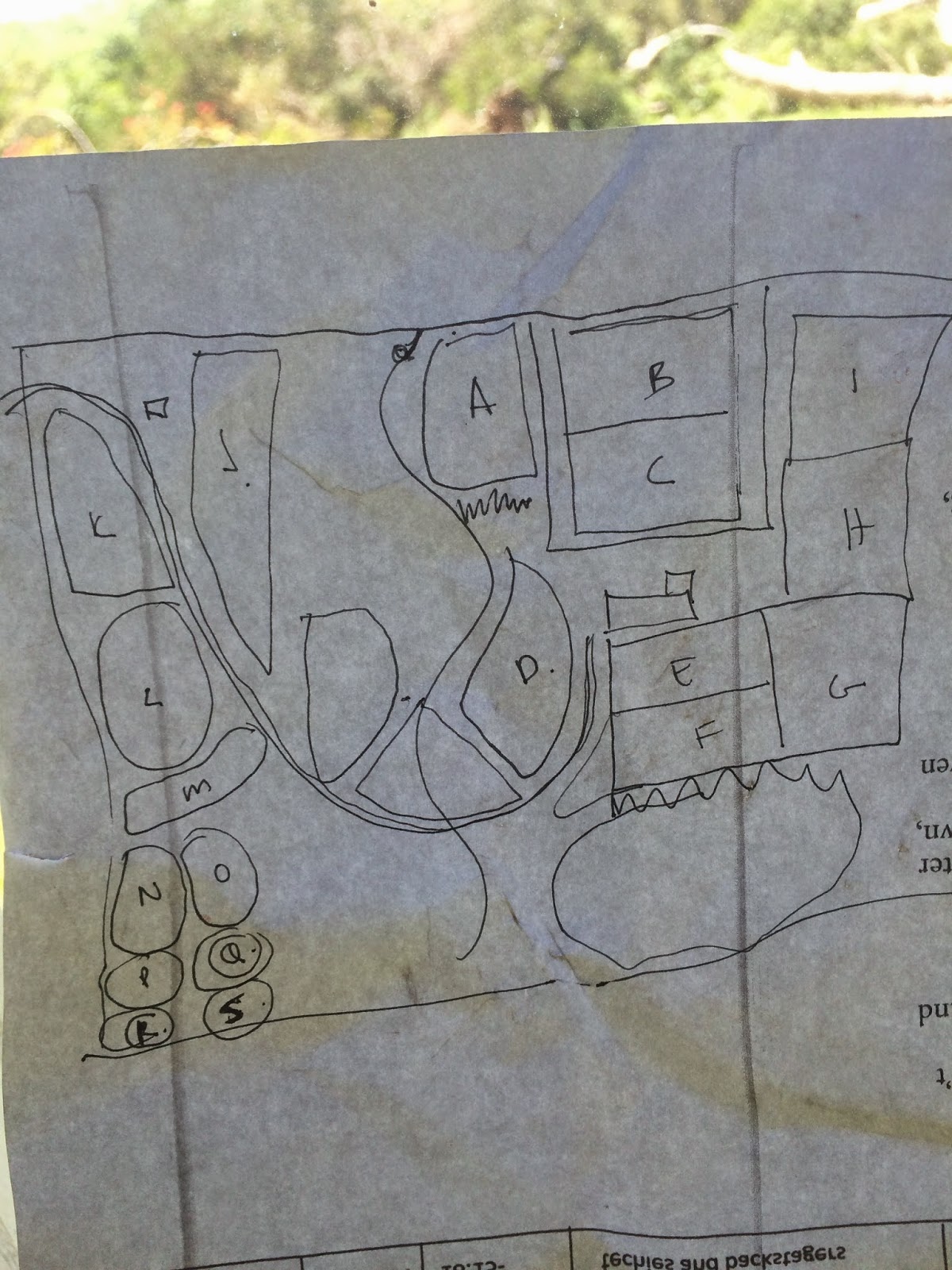
So how it practically works though the week, it that Mandoza (my trusted assistant) moves the cattle to new grazing every day. I prefer to move them in the afternoon when the sugar content of the grass is higher. I have a simple diagram which I leave in the cottage so Mandoza and I can refer to camps by alphabetical letter. We talk mainly by texting through the day. I charge the battery for the electric fence here at home and once or twice a week I would make sure a newly charged better is taken to the farm. If we use this configuration we have 20 camps. so that would mean that would mean that each camp would get 20 days rest if each camp were grazed for one day. Of course depending on rain and time of the year, 20 days may or may not be enough time for the grazing to recover, so the idea would be to vary the size of the camp accordingly. I can see now that we have had some rain and the days are warmer, the grass is looking good and I can keep the size of the camp quite small, giving me perhaps 30 or 40 camps in total. The grazing is looking quite healthy, If I compare it to my neighbour’s place where he has sheep, cattle and goats continuously grazing the grass down to about 50 mm high, then we are looking very good.
I am also slowly, but surely expanding the pasture. Over the weekends I spend time with the chainsaw cutting out the alien invasive species: Black Wattle, Port Jackson, Inkberry, Blugum, Poplar and Cape Wattle. I start buy cutting paths just wide enough to run the electric fence in. I create a camp in a forested portion. The cattle eat some and stomp down other parts including brambles and vines making it easier for me to come in with the chainsaw. I find it does not take long for the grass to begin to establish in areas where I have opened up the ground to new light that was previously blocked by tree cover. Anyhow, I enjoy working with the cattle. I see them as my landscaping assisants. We work together to bring this farm to be the most that is can be,
Making way for something better.
The thing is, I have refused to accept that my life would become ordinary. I have refused to accept that I would be satisfied with a 40 hour work week and a pay check. I have refused to accept that I would be satisfied with a life that requires me to focus for its duration one specific discipline, one specific focus, one specific profession. But this has caused me some pain and some confusion and some clutter. I can see how, in my defiance I have taken on more and more projects and responsibilities. The assumption in the back of my mind being that I am some kind of superman that has no limit to my ability to take on new stuff. But now, for the last few months at least I have begun with a campaign of cutting down. Taking on the farm has made me realise, number one, that this is what I really want to get right. If turning the farm into a healthy, vibrant and productive family place (perhaps like it may have been many many years before) is the one thing I achieve in my life, then I will consider that a life well spent.
Or at least this is what is running through my head as I dismantle the Hothouse that I built in 2011 to house my aquaponics pilot project. At the time I had expected it only to last a year or two so the time is right for it to go. The real pressure for it to go has of course come from my children and from my wife. They would like things to look a little neater in the backyard. I can resist. I can be forceful, but that would also not be right. So down comes the hothouse.
I had built the entire structure from scrap timber. Timber that I bought from a scrap dealer, called DIY Timber but scrap nonetheless.

I put everything together with my Ryobi Hand held electric screwdriver / drill, so taking it apart gain, involved me unscrewing the boards and the brackets. This allowed me to save most of the timber which I have now taken to the farm. I will probably use it for a new hen house project I have in mind. I must say though, that I learned a lot from taking down the hothouse. I could see what worked and what did not. The plyboard that I used to form the circular from were not a good idea. They did not hold their shape. The tunnel plastic was great. It did begin to rip but only in the top point which had a poor detail that was too sharp. I learned from this hothouse in order to be in anyway warm in the winter months, every minute of sunlight must be captured. All shadows must be avoided, and by the same token, things can get very hot in mid summer, not for the Tilapia, they love worm water, but for some of the plant species, so some way to ventilate is critical.
The timber has generally held up very well over the last three years, but where it has been in touch with moisture, either in direct contact with the soil or where tanks or filters cause continuous moisture, the timber has begun to show signs of rot.
By taking this structure down I now make it possible to build a better one. One that is an improvement on the first one. I would not be able to build a better one if the old one is still there, or it is unlikely, because some of the components need to be re-used and because it just never becomes a priority above the other items on the to do list. But what other parts of my life and my schedule have become old and tired and need to be taken down to make way for new possibilities? Or am I extending the metaphor of the hothouse to where it does not belong. Are there some parts of the the way I do business, the way I practice as an architect, the way I invest my money, the way I spend my time, that can be dismantled, pulled apart to make way for something better. Maybe and I can see that is what I have been doing in the last while. Cutting down slowly. realising that I am human and can only do so much in a given day and in doing this maybe, just maybe, I am making way for something better.

