Category: All Posts
Freedom is our Heritage. It belongs to us.
Well today is Heritage Day, but is so wet here that I cant bring myself to make a braai. Its quite interesting actually that the idea of having a braai on Heritage day has caught on. Because, if I were to question people I meet in South Africa everyday and ask them about their heritage, they will most often speak about their specific national, tribal or language identity. In some cases the individual may also have some kind of clan or family heritage that they like to speak about. Heritage, for so many of us has been about trying to answer the question “How are you different from other people?” Well I am not sure that’s the only way to think of it. There are so many things that we in fact have as a common Heritage. That’s why I like the idea of “Braai” day, because no matter who you are, your ancestors at some stage cooked meat over an open fire. This is an in and inescapable truth and a comforting ritual that we are all still drawn to in some way. We are all drawn to music, we are all drawn to conversation and laughter and we are all drawn to being outside and breathing fresh air. This is our common heritage and this is what we should be celebrating. In my life these are the things that I celebrate. The minuscule and scientific differences between us are not of such a great fascination to me. Rather I see as academic, the differences between Irish Whiskey and Scotch Whiskey, I see as academic the differences between Rooseterkoek and I’rostile. I see as academic the difference between Pot Roast Chicken and Umleqwa or Umqa and Pap.
Two dead Chickens
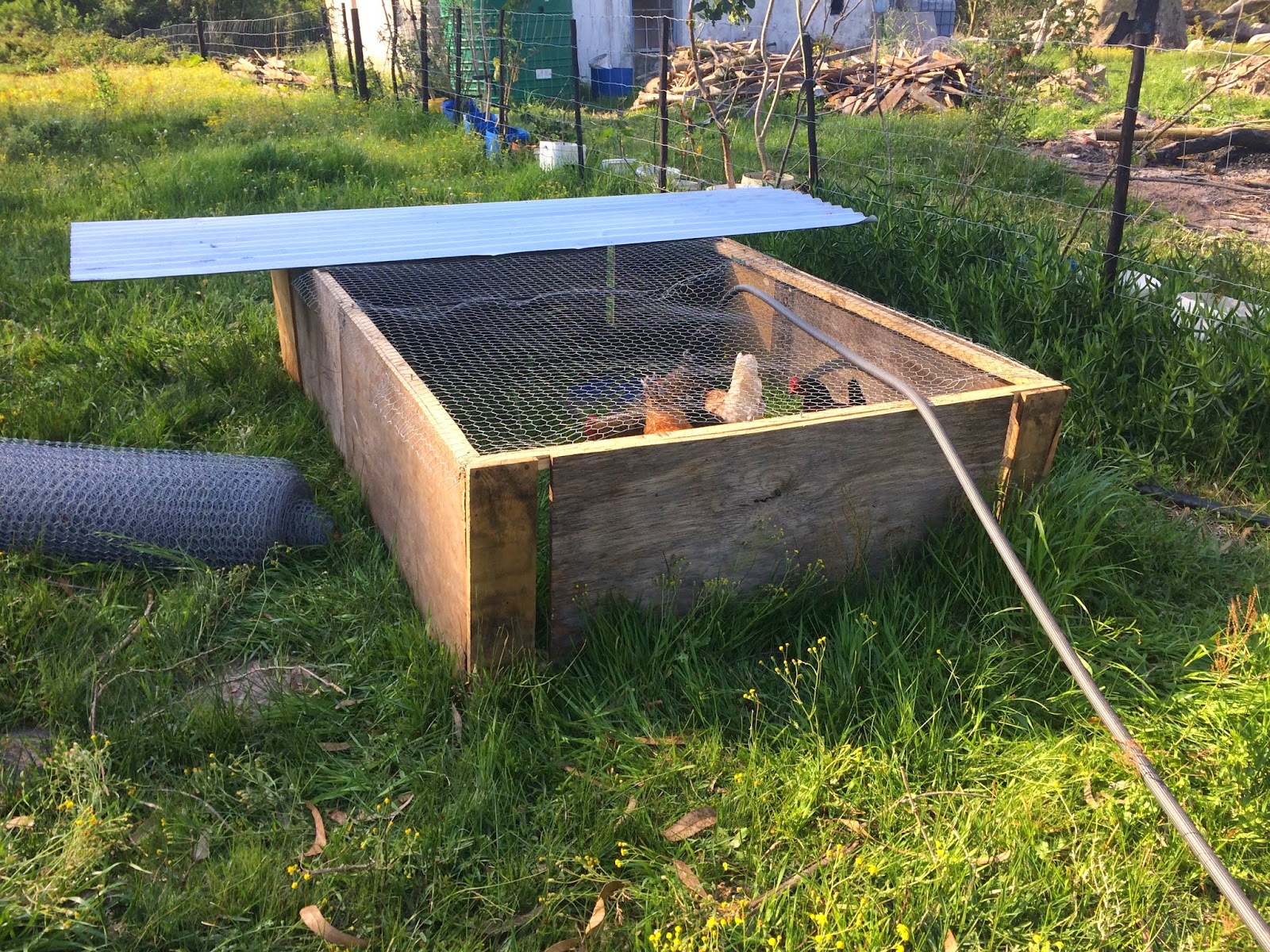
Its not that I expected it to happen, but I am not surprised. Two chickens were taken last night, probably something as small as a mongoose. It must have slipped under the frame of the chicken tractor. We have re-enforced the pen now, by adding a trim of chicken wire that I believe a mongoose may not be clever enough to dig under.
I suppose the other way to have gone about this would have been to have built an absolutely impenetrable concrete and brickwork fortress for the chickens. Something that would have taken a year and something that could withstand any attack including hurricane and leopard. But I don’t think that’s the approach that I care to take. What I am trying to get right at the farm is efficiency in design. The question I continuously ask myself is: What is the appropriate response?
I suppose this is what I am trying to get right in my life. Because I can be cautious but it may stop me ever setting a foot out the door. Or I could be reckless and risk hurting those that depend on me. Too much caution is bad. Too much recklessness it bad. But what I am doing with the chickens and what I am doing on the farm generally, is observing. Taking and action and observing the response of the farm.
Through the action of introducing the chicken tractor, I have been able to observe that I have a mongoose challenge. I can now prepare a measured, sensible response to the mongoose challenge. I can respond with design. The kind of design that does not destroy habitat. The kind of design that is the gentlest possible intervention to address the challenge.
Do you see how this is different to the approach of conventional agriculture, conventional medicine or conventional city building.? In conventional agriculture where we find we have insect challenge we introduce insecticides and destroy all insects, good bad or indifferent. We do not take the time to observe and develop a measured response. In medicine we respond to microbial infections with antibiotics. We do not take the time to observe. We annihilate all bacteria, good bad or indifferent. In city building we act against variety, where one noisy business upsets one complaining resident, we abolish all mixed use suburbs and replace them with a monoculture of residential, a monoculture of offices and a monoculture of factories. We act in this way perhaps because we are afraid of things going wrong. We are afraid to make mistakes. We are afraid perhaps of the ridicule or the mockery, So we become cautious. We make very safe decisions that cant possibly go wrong. We get life cover, medial aid and short term insurance. We get cars with a “motor plan”.We get safe jobs that promise a pension to look after us so we don’t embarrass ourselves by being a burden by making the mistake of running out of money before we die.
But of course in all this cautiousness our dreams are postponed and the richness of what could have been our lives becomes displaced with a life of slavery to those that offer the promise of comfort and security. This life my friends, is not for me. And yes there will be some blood and guts along this path.
But this is the path that I am committed to walk.
ECIA Chair slates ‘too big to fail’ developments
This piece appeared on the mype.co.za website on 6 September 2014. It captures some of my views on the city and the profession at the moment.
ECIA Chair slates ‘too big to fail’ developments
The past two years have seen the Eastern Cape Institute of Architects’ (ECIA) take on a higher level of advocacy and engage more actively with the public, business and government to educate and share the power and joy of the art of architecture; and on how design can be used for good.
Moving the Chickens
I am not entirely sure that I am ready to move the chickens to the farm, but its done, I moved them today on the back of a hired trailer, with a whole lot of potted trees from my hothouse which I am busy dismantling. All but the one hen that is broody and sitting on eggs.
I am sure I could have built a better shelter for them. In fact I have a much better one planned, drawings and everything, but like with so much in my life, this is what I am able to do now, with the time and resource that I have. I console myself by saying it is a temporary solution. But I say this as I look around my study on the Sunday evening with all many of the temporary shelves, piles of books, heaps of tools un-carpeted floors and skew hung posters, which were all “temporary ” solutions.
How much too in my business is the result of pragmatic thinking. “This is the best that we can do, let it out the door, or run the risk of missing the deadline”.* But is it not in this way that my life becomes a sequence of compromises. Is it not in this way that I miss on the opportunity to do great work, lovely chicken sheds, great articles, beautiful buildings? But perhaps its better this way. Rather a life of compromises than a life of waiting for the time to be right. Waiting for the movement to strike. But never taking action, Never doing stuff, because the circumstance is just not right. I don’t know!
But I do know that we have 5 fowl in the new pen. One hen got out when I was moving them out of the transport cage. I hope we can somehow get it back. I will ask Mandoza if he can think of a way to catch it tomorrow. The danger of course is that unknown predators roaming the farm kill all the chickens tonight. I have not yet taken the time to make the shelter “dig under proof”.
I will keep you posted. Lets see how it goes tonight.
* In a way too, this blog is a battle between getting something out and getting something right. I would like the blog to have more meaningful articles. I would like there to be thorough videos explaining some of the things we do. I would like the photograph to be of better quality. But I suppose if I waited for all those things to happen, I would never put a blog out at all!
update – 8 9 14
Chickens all still alive this morning and I managed to catch the one that got out. (I popped into the farm on the way back from a meeting nearby.
update 11 9 14
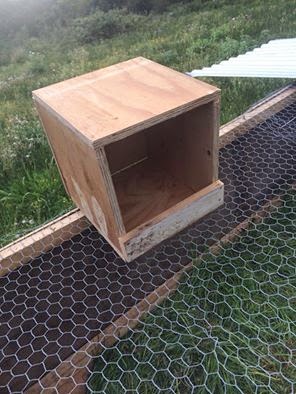
Added a nest box this afternoon.
A simple design of 300 X 300 boards cut from a 19 mm Shutterboard sheet. A little plank across the front to keep the eggs and nesting material in. Then simply screwed into the side wall of the Chicken Tractor.
The chickens seem happy. The peck at the grass all the time and scratch in it. Mandoza is moving them to new grass every day. So far so good. No predator attacks. I put a bunch of Bluegum leaves in for them to nest in. I heard somewhere that Bluegum leaves are some sort of natural bug repellent.
We’ll see!
A Place of Power
I have been cleaning up the yard a bit at home. I suppose now that we have the farm, I have little excuse left for turning our sub-urban backyard into an ongoing agricultural experiment. We have veggies, fruit trees, grape vines, Tilapia, a duckweed pond and a chicken run. I am under pressure to move the chickens, the grape vine, the tree nursery and the Tilapia hot house out of the back yard and on to the farm.
But its kind of sad. I know I am making space for bigger and better things, but I still have a vision for this backyard, that will now remain unfulfilled. I would have like to have completely taken out the lawn and replaces it with a tree nursery or chicken forage. I would like to have drained the pool, roofed it into a Tilapia aquaponic garden hothouse. I would have liked to have gone further with rainwater harvesting, composting and grey water systems.
But in clearing out the yard, I am also taking stock. I am clearing out the rubbish that has accumulated. Burning those short bits of timber I thought I would use here and there. Its funny, its almost as if all this stuff grows to have some power over me. And as I burn it I feel the power return to me. Too much stuff! That’s the real problem. We get more and more of it and it begins to mess with our minds. It begins to take my personal power.
I am not sure that I know what I mean by “personal power”, but I have come to see that inside me there is a personal energy or “power”. Some days it is stronger, some days it is weaker. I can feel it change sometimes. If, maybe somebody close to me says something hurtful. I feel my power diminish. If I am doing physical work, I may feel tired, as if though I cannot go on. And piles and piles of disorganised stuff has a similar effect on the energy. This “power”. It makes me feel weak and discouraged.
This realisation is behind my drive to simplify, to live with less. I can see that living with less will give me greater vitality and greater strength. I have go no idea why, of course. But, the mechanics of this phenomenon are not as important to me as the absolute knowledge, that for me, in my life, the less clutter there is, the less noise there is, the less stuff there is, the stronger I feel. And, what’s more, I notice that its like some sort of spiral effect, because the stronger I feel, the more I am able to do to rid myself of those things that are making me feel weak, so I, in turn become stronger again.
My quest , and I suppose, many of yours to, is to find my strongest self, my fullest self. All else flows from there. My ability to love and give. My ability to lead and contribute, all of these are by products of a strong self.
So, as I step back into the work week tomorrow, let me remember the feeling of power and strength I hold today. Let me carry it with me to the meetings, in the proposal and the reports. Let me remember that the place from where I come is a place of power.
Some Perspective
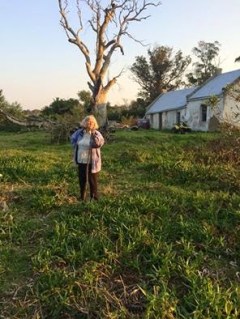
I went out to the farm with my mother on Sunday. She helped me identify some of the trees that I don’t yet know. But also by her just being there with me it helped me gain some “lifetime perspective”.
![]() |
| My Mom |
A perspective that helps me see that its OK if things take the time that they need to take. Its going to take a lifetime sculpting this land, this giant garden. The task will never end. My learning, I am sure will never end. I see this time now as just the beginning of the relationship. The “getting to know each other” stage.
I wish I could tell you more about what has been done, since last I checked in, but to be honest, I have been really busy in business. I have been toiling, mostly mindless toiling, the kind that I just have to do to keep afloat. The kind of toil that makes me wonder if there is a different way, a simpler way, perhaps a more beautiful way for me to live out my life. A direct way. A way that cuts straight to the chase. A way that does not see everything as a means to and end. A way that is the end in itself.
I spend so much of my time doing stuff, not that I want to do, but what I am required to do in order to achieve an objective and so much of the time even the objective that I am trying to achieve is not actually what I want but rather just something that helps me achieve another objective which is not what I want but helps me achieve the next objective. Yes I can see the insanity in this cycle and you can see the insanity in your own life, but just because I know the question does not mean I have the answer. I can see the treadmill that I am on, but that does not mean I know how to get off. And without wanting to push the metaphor too far, I can see that it really is possible to fall quite hard once you realise you are on a treadmill and look around, take your eye off where it should be and loose a footing, tumbling face forward and head over heals.
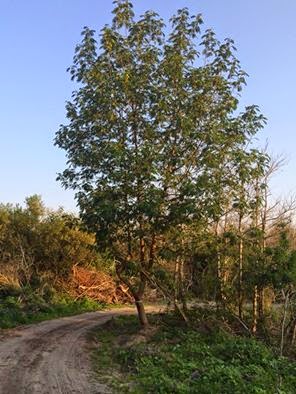
I tried not to think of these matters while I was out in the forest with the trees and my mom, where we found a tree that I very much hope is indigenous, but looks very much like
![]() |
| What tree is this? |
the Australian invasive Acacia Mearnsii (known here as Black Wattle). As far as I can see its an Acacia Caffra, but some of my clever friends think is could be Peltophorum Africana.
Its not that I have a facination with latin sounding names or the classification of each plant and tree, but rather just that I would like to know if they should be chopped down or not. If they are invasive, then they are just going to cause me more work over the years as I have to keep them out of areas I don’t want them to be in.So if anyone reading this blog can identify this tree or perhaps knows a internet group or forum that is likely to be able to, please let me know.
My mission in the next few weeks is to get going with planting potted trees that I have been moving from my house in Walmer. My mom tells me its late I should have planted in autumn already. Here I was holding on until spring, but I will plant anyway.
The other project that is becoming urgent, is for me to move the chickens to the farm. Two of the chickens have turned out to be roosters and have taken to crowing early in the morning, I am sure upsetting the same neighbours who complained last time I had a rooster. So watch this space for chicken coop progress.
![]() |
| The Mystree tree |
The Crisis in South African Cities within the context of the entrenched dysfunctional relationship between Urbanists in the Public, Private and Academic Sectors
(This Paper was first presented on 5 August 2014 at the International Union of Architects – World Congress in Durban. – It was presented at the “Parallel Academic Sessions” after a lengthy process of abstract approvals and double blind reviews.)
Close to half of South Africans now live in towns and cities. There is no evidence of the slowing of this trend. The 2011 Census shows us that rural provinces like the Eastern Cape have a declining population while urban centres like Gauteng show massive growth in population at rates very difficult to plan or develop for.
The growth pressure on South African cities in the last 20 years has of course been the engine driving change in the country, because where there is growth there is a drive for transformation. This has necessitated a profound “re-visioning “and re-imagining of what were old colonial and apartheid cities. This urbanization pressure has created the perfect opportunity for change. Nowhere else on the globe since the rebuilding of Europe after World War 2 has there been a need for urban spatial transformation as here, in post-apartheid South Africa. There are great obstacles to change including our limited resources, our old paradigms and our vested interests. Not surprisingly the process of spatial and physical transformation has been a flawed process. No matter how you look at the current reality in South African cities, twenty years into democracy, all can still, without exception, be described using the terms “Town” and “Township”. (Those of you from outside the country are reminded of Apartheid spatial planning’s dictate that black residents be located outside of “town” in dormitory “townships”.)
All of our cities are currently characterised by:
• Inner City areas facing decline, degradation, increased vacancies and deflated rentals.
• Middle class suburbs remain crime affected and under siege from roaming criminal gangs.
• Government subsidised housing is very poorly located, very poorly serviced and of very poor quality.
• A lack of spatial integration (denying, particularly the poor and new urban immigrant’s access to critical urban resources and the urban economy).
In spite good policy documents, South African cities have continued to become massive sprawling, polluting, fossil fuel dependent, urban regions that experience high levels of crime because of shortcomings in the urban economy and the weak social infra-structure. These cities are in many ways monuments to inefficiency, social dislocation and environmental degradation.
To this day, our cities remain memorials to apartheid’s most visible and viscous social engineering projects; divided between rich and poor, black and white and well serviced and poorly serviced. But what is perhaps worse, is that far from turning around this inherited pattern, the forces acting on our model of development since 1994 have rather perpetuated and reinforced the failed pattern.
As we speak, this pattern is playing itself out in the city that has been home to my family and to my architectural career. The Nelson Mandela Bay metropolitan area will, in the coming months see massive new sprawling developments beyond Motherwell to the east and outside Sherwood to the west of the metro. The process is now well underway to obtain approval for a new R6 Billion “mixed residential” development beyond Motherwell, along the road to Addo and construction has already commenced on massive new regional shopping centre to the west along the N2.
Curiously this crisis in South African Cities continues at a time when there are skills and resources available in the public, private and academic sectors to address these challenges and in fact to transform our cities into vibrant models of balance, harmony and sustainability.
It is therefore the position of this paper that the most significant obstacle to meaningful urban transformation in South Africa lies not in a shortage of academic “know how”, not in a shortage on public sector investment, not in a shortage of private sector mobilisation but rather in the entrenched dysfunctional relationship between these three sectors.
Each of these sectors operates increasingly as a “silo”, separate from each other with no mechanisms available for true collaboration. The public sector has become driven by a number of imperatives that require it to “procure” the “services” offered by the private sector in a standardised mechanism designed to “procure” other “goods and services”. The obvious fact that public and private sectors can best serve the urban crisis by contributing the best from their ranks to collaborate in providing, vision, leadership and direction is of no concern to the faceless authors of our public sector’s “supply chain management” procedure. The unavoidable nett result of this strategy is a contested, completely unproductive standoff between the public sector “urban silo” and the private sector “urban silo”. No vision emerges from this standoff; no leadership emerges from this standoff. Only “safe”, “compliant”, “cost effective” implementation.
In a similar way urbanists in the “academic silo” come under increasing pressure to focus not on the South African urban crisis, but rather on “purer” academic pursuits. A youngster with a Phd that deals with some arcane branch of architectural theory is much more likely to assume a professorship in Architecture than a practitioner with 20 years’ experience in city building. This trend seems unstoppable with a momentum developed from very high up in the South Africa’s higher education community. Architects who teach are now actively discouraged from participating in private practice. Those from private practice, who give of their time to the university and share their experience generally, do so as volunteers. Academics offering to serve the public sector are treated the same as their private sector counterparts, as a commodity to be bought through a “procurement system” with the same resultant frustration.
While in architectural practices everywhere we find that the energies of the brightest minds are committed to pure commercial pursuits. Top Architects, in top firms dedicate a disproportionate amount of their time on bids, tenders and RFP’s. When the projects are moving, architects at the top of their game commit most of their valuable time and energy in “managing risk”, resolving conflict and ensuring cash flow. Very little time here for reading, studying, engaging or developing the perspective that we know is required to see the bigger urban picture.
In this way the silos grow more and more isolated and positions within them become more and more entrenched. Urbanists of otherwise impeccable credentials begin to withdraw into cynicism and isolation. Great ideas are shelved. Big visions parked. Energy diverted.
Is there any solution? Is there any alternative to these dysfunctional relationships? Is there any way out of this urban crisis? Of course there is. These challenges were made by people like you and I and they can be overcome by people like you and I.
In light of the above, we put it to this conference that the following are now accepted as “common cause” by the three “sectors”; academic, public sector and private.
• Firstly, progress in addressing the crisis in South African cities is significantly dependent on the effective collaboration between “Urbanists” located in the public, private and academic sectors.
• Secondly, effective collaboration is substantially obstructed by current public “Supply Chain Management” procedures.
• Thirdly, effective collaboration is significantly obstructed by current Higher Education human resource management practices.
• Fourthly, the burden of Research and Development required to address the Urban Crisis is not shared in any helpful way by the Architects located in the private sector.
If the above can be taken as consensus, then this paper then makes the following propositions which it calls on the conference to debate:
Proposition Number 1
This paper argues that Architects in private practice have a meaningful role to play in developing vision and solutions to many of the challenges that face our rapidly growing cities. It is further argued that practicing architects are, as a by-product of their professional practice, daily exposed to up to date, complex data that informs and frames the questions and challenges that make up the urban crisis.
The limiting challenge however is that a formalised structure to support and facilitate the assimilation, processing and sharing of this data does not exist to the same extent as this exists in South Africa’s Universities. Universities all have a long established, structured set of incentives that promote research and debate.
Architects in South Africa are organised, primarily though the South African Institute of Architects. A number of programmes are run by this voluntary association to ensure the “Continuing Professional Development” of its members. In its turn, the regulating authority, South African Council for the Architectural Profession (SACAP) determines what is deemed to be an adequate amount of “Continuing Professional Development” in any given 5 year cycle. Within this environment, very little emphasis is placed on ensuring that research outputs of the profession are captured in any meaningful way.
The proposition put forward in this paper is therefore that:
The South African Institute of Architects is best placed of all institutions to formulate a systematic research process that captures the collective wisdom emanating from the work of practicing architects in the rebuilding of South Africa’s cities and that it will be failing in its mandate toward “Architects and Architecture” if it does not develop programmes to address this challenge.
Proposition Number 2
This paper points to the uncontested fact that University Architecture departments through the country have displayed a “drift” away from professional emphasis toward a greater academic emphasis. This is evidenced by the growing proportion of junior and senior teaching staff at Architecture departments with little or no professional exposure or credibility. This weakness arises from the fact that Architecture departments are located within universities where they experience significant pressure to conform to “uniform standards” which align the seniority of teaching posts with equivalent academic achievement. There exists no framework at any South African University to equate professional achievement with appropriate post-graduate qualifications meaningful to selection panels considering applications for teaching posts in Architecture departments around the country. While the South African Council for the Architectural Profession is mandated to accredit schools of architecture, no part of its directives to schools of architecture include the need for teaching staff to have has any contact or exposure to the profession of architecture.
The proposition therefore put forward in the paper is that:
The South African Institute of Architects is best placed to ensure that The South African Council for the Architectural Profession, develops expands its guidelines for the accreditation schools of Architecture to include minimum levels of professional experience for various categories of teaching positions.
Proposition no 3
While some architectural services procured by the public sector are of a routine and basic nature, others call for the Architect to provide significant leadership and vision. No evidence or research has been presented by the public sector at any conference or in any publication to suggest that leadership and vision can best be obtained from private sector architects using the current supply chain mechanisms uniformly adopted by Local, Provincial and National government departments. In fact, the documented evidence of Architects failing to provide adequate leadership in public sector projects grows as procurement process dictated by National Treasury become more uniformly employed.
This “supply chain” practice continues in spite of a number of workable examples where leadership and vision is procured by the public sector using free, fair and transparent processes. These examples include the long list of Director’s General, Municipal Managers, Chief Financial Officers and CEO’s of development agencies who are all procured in interview and shortlisting procedures without the need to submit a competitive financial offer.
The proposition therefore put forward in the paper is that:
There is no institution better placed than the South African Institute of Architects to commit to a comprehensive research project to test the hypothesis put forward in this paper that:
“Current South African public sector supply chain management processes, do not match the best Architectural skill and talent with the tasks that most require these skill and talents.”
Conclusion
This paper calls on this conference to debate the above three propositions with a view to accepting, rejecting or refining the position. The intention is then that this paper, in its refined form, becomes a call to action for South African Institute of Architects, to step into a leadership position in the task of ensuring that the energies of South Africa’s architects are best directed to the growing Urban Challenge facing this country and this continent
Is it fair?
The Brown Cow, that the kids have named Daisy, had a still born calf on Friday. I am not sure if I should worry about this. It is her first calf, perhaps she took the bull a bit too soon, perhaps she is not getting all the nutrients she needs. Its sad. It would have been nice to have a calf on the farm.
![]() |
| Each window of the old cottage is different. |
I really did not get much time to get out to the farm in the week. (I speak a little more about the frustration and joys of what I deal with in the week on another blog of mine). I popped in on Wednesday afternoon and took some measurements for the new casements for the timber windows. Over the weekend, today and yesterday, my time was also quite limited. Yesterday I had to fetch and carry kids to drama practice and had to get some work done at home in the morning first. Today may daughter came out to the farm with me in the morning. We had great fun, but got only a few things done before she was bored and desperately needing to go to McDonalds for lunch. I love spending time with her. I love spending time with my family and being available to them for the things that they need my help with. So I am stretched. So little time. There is a mountain of work that needs to be done on the farm, if I can ever dream of moving my family there, but to get to that mountain is a real challenge. Work on the Cottage is an urgent priority for us. I really want to spend time myself getting it done. I am not afraid to hire people to help me, but only to the point where I trust that they will not do more damage than good.
![]() |
| Is climbing a tree more fun than watching someone climb a tree on TV? |
Is it fair on my family for me to take on this project? Is it fair of my family to expect me to be available all the time for their projects (at the expense of mine) ? I don’t know. Right now my family is sitting in the lounge, by the fire watching “Idols” (I don’t know if you can call it a project, but it seems to be quite and important weekly event a least). But I am here, in my study cleaning my chainsaw, or planning the house or scheduling the tasks on the cottage of the week, or talking to you guys. Is that fair of me? Or should I be watching TV?
And another thing. Is it fair on my family for me to develop an attitude toward my office and the business I have built, that may see me being less inclined to see myself as its slave? What if this attitude results in me bringing home less money? What if child number three can not have as much money spent on her as child number one? Would the family understand? Would I not regret this?
The farm is not just a property deal. We have bought a few properties over the years and those have always been about the spreadsheet. What rental can it generate? What can I re-sell it for? And while I can see that Pebblespring is a good investment, its more complicated than that, because I see Pebblespring as part of strategy to simplify, to spend less and to live more fully. But this is a family project. It is a project for all of us. The reality of course is that we all see things differently. We all love the farm, but are not all equally on the same page about simplifying and spending less. While I am quite comfortable to lead this process, I am very concious of not leaving anybody behind. Not creating a gap between me and the others in my family. I am not separate from them. We are a whole. But we are all our own people, with our own minds.
![]() |
| Yellow rectangle is new house position. Yellow lines access. Blue lines water |
In other news, I have been thinking a little more about the new house we plan to build after finishing with the renovations of the cottage. The new plan is to have it a little closer to the cottage, so as to form the second edge of a farm yard, (with the existing cottage being the first edge).
The way I prefer to think is to sit with an idea for a while and see if it “resonates” If it still feels good in week or two or is not replaced by a better one, then perhaps we move to the next level. Slow moving, but solid.
So I will let you know if the thinking stays stuck.