Author: Tim Hewitt-Coleman
Are we there yet?
Snakes Alive!
Anyway, the snakes turned out to be two Spotted Bush Snakes Philothamnus semivariegatus. (thanks to the people at snakesofsouthafrica for help with the identification) which are not poisonous at all. There are dangerous snakes on the farm, like the Puffaders that like to lie on a sunny path waiting to be stepped on. What I am trying to say though, is that we are confronted everyday with a strong bombardment of ideas of what is “normal” and what is not. We are told that “Normal” is to work in a cubicle, commute to work in a Toyota Corrola, and watch rugby on Saturdays. So it is with normal dangers that confront us every day in the city. Because they are “normal” we tolerate them. Even when they kill us, we continue to tolerate them. But snakes, scorpions and frogs are “abnormal” dangers and they are to be eradicated, chopped into little pieces, burned, poisoned and obliterated. Such is the logic of our time.
So, while I can see that all this, to keep the peace I have had to make a visible effort to do something about the snakes. So I have cleared all the longer grass around the house and reduced the number of places snakes can hide. And also very cleverly I have installed a very innovative anti snake device onto my watertank.
You can watch the video if you like.
So, How have the cows been?
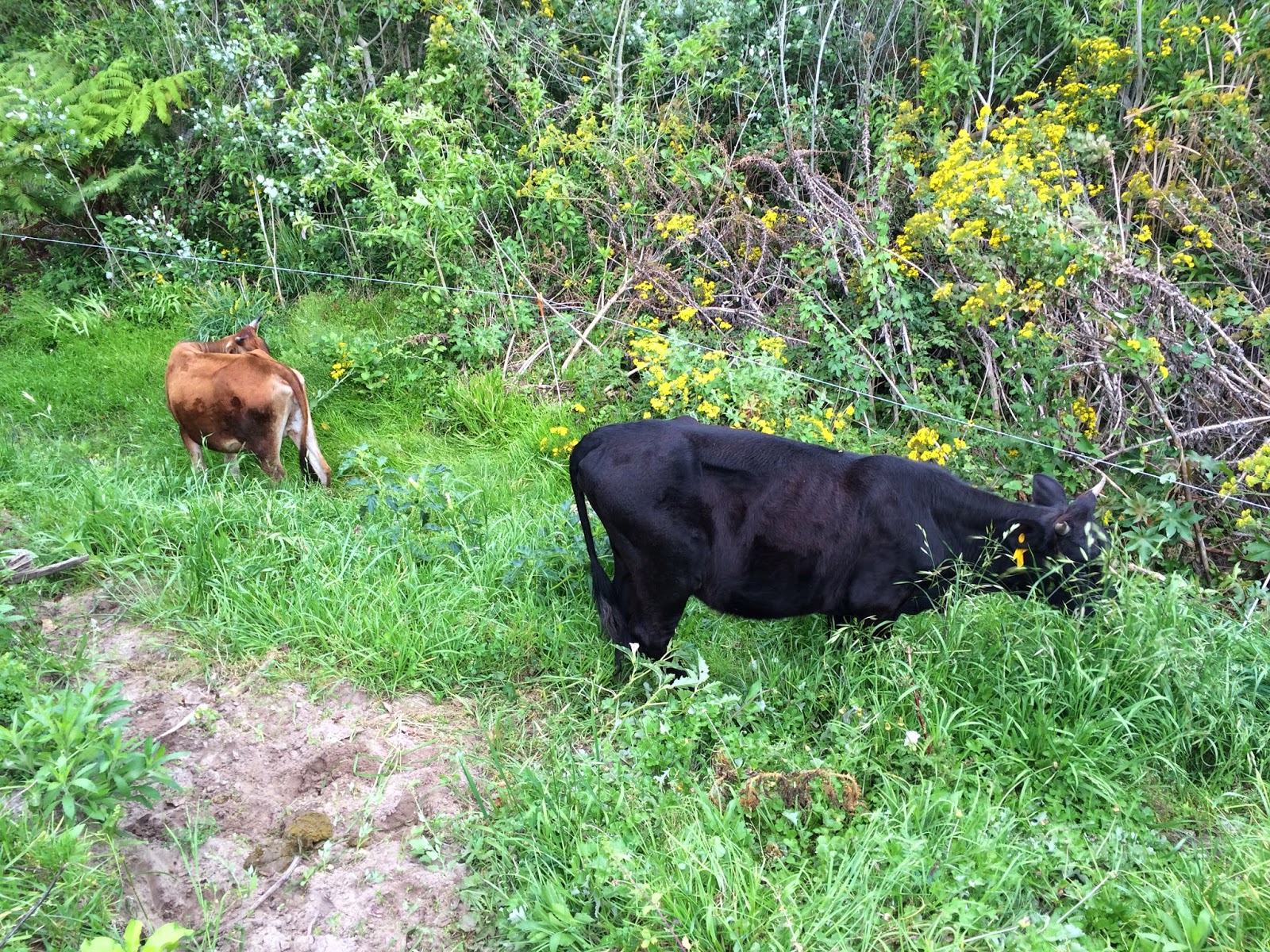
I have not spoken much about the cattle since I lost the calves and the bull. But is actually going quite well now with the two heifers. A brown one and a black one. We move them to new pasture everyday with the portable electric fence.
We keep the “camp” small enough to ensure that they graze everything down (not just the tasty stuff). Cattle are picky eaters, they will first go for the greenest grass and then try the other stuff if they have to. So by keeping the camp just the right size I can ensure that they get enough, but that they don’t just pick and choose the best grazing. The important part of this strategy is that all the unpalatable stuff gets eaten as well, making space for other species to come through. The exercise is really all about building the soil. The cattle improve the soil in three important ways:
- They leave there manure behind – adding the nitrogen that’s crucial to get life going in the soil
- When grass is grazed, it automatically cuts off the proportionate amount of roots underground (thus adding much needed carbon to the soil)
- The animals hooves disturb the soil surface helping seeds get a chance to germinate.
Making way for something better.
The thing is, I have refused to accept that my life would become ordinary. I have refused to accept that I would be satisfied with a 40 hour work week and a pay check. I have refused to accept that I would be satisfied with a life that requires me to focus for its duration one specific discipline, one specific focus, one specific profession. But this has caused me some pain and some confusion and some clutter. I can see how, in my defiance I have taken on more and more projects and responsibilities. The assumption in the back of my mind being that I am some kind of superman that has no limit to my ability to take on new stuff. But now, for the last few months at least I have begun with a campaign of cutting down. Taking on the farm has made me realise, number one, that this is what I really want to get right. If turning the farm into a healthy, vibrant and productive family place (perhaps like it may have been many many years before) is the one thing I achieve in my life, then I will consider that a life well spent.
Or at least this is what is running through my head as I dismantle the Hothouse that I built in 2011 to house my aquaponics pilot project. At the time I had expected it only to last a year or two so the time is right for it to go. The real pressure for it to go has of course come from my children and from my wife. They would like things to look a little neater in the backyard. I can resist. I can be forceful, but that would also not be right. So down comes the hothouse.
I had built the entire structure from scrap timber. Timber that I bought from a scrap dealer, called DIY Timber but scrap nonetheless.
I put everything together with my Ryobi Hand held electric screwdriver / drill, so taking it apart gain, involved me unscrewing the boards and the brackets. This allowed me to save most of the timber which I have now taken to the farm. I will probably use it for a new hen house project I have in mind. I must say though, that I learned a lot from taking down the hothouse. I could see what worked and what did not. The plyboard that I used to form the circular from were not a good idea. They did not hold their shape. The tunnel plastic was great. It did begin to rip but only in the top point which had a poor detail that was too sharp. I learned from this hothouse in order to be in anyway warm in the winter months, every minute of sunlight must be captured. All shadows must be avoided, and by the same token, things can get very hot in mid summer, not for the Tilapia, they love worm water, but for some of the plant species, so some way to ventilate is critical.
The timber has generally held up very well over the last three years, but where it has been in touch with moisture, either in direct contact with the soil or where tanks or filters cause continuous moisture, the timber has begun to show signs of rot.
By taking this structure down I now make it possible to build a better one. One that is an improvement on the first one. I would not be able to build a better one if the old one is still there, or it is unlikely, because some of the components need to be re-used and because it just never becomes a priority above the other items on the to do list. But what other parts of my life and my schedule have become old and tired and need to be taken down to make way for new possibilities? Or am I extending the metaphor of the hothouse to where it does not belong. Are there some parts of the the way I do business, the way I practice as an architect, the way I invest my money, the way I spend my time, that can be dismantled, pulled apart to make way for something better. Maybe and I can see that is what I have been doing in the last while. Cutting down slowly. realising that I am human and can only do so much in a given day and in doing this maybe, just maybe, I am making way for something better.
Who will champion PE’s ICC?
Freedom is our Heritage. It belongs to us.
Well today is Heritage Day, but is so wet here that I cant bring myself to make a braai. Its quite interesting actually that the idea of having a braai on Heritage day has caught on. Because, if I were to question people I meet in South Africa everyday and ask them about their heritage, they will most often speak about their specific national, tribal or language identity. In some cases the individual may also have some kind of clan or family heritage that they like to speak about. Heritage, for so many of us has been about trying to answer the question “How are you different from other people?” Well I am not sure that’s the only way to think of it. There are so many things that we in fact have as a common Heritage. That’s why I like the idea of “Braai” day, because no matter who you are, your ancestors at some stage cooked meat over an open fire. This is an in and inescapable truth and a comforting ritual that we are all still drawn to in some way. We are all drawn to music, we are all drawn to conversation and laughter and we are all drawn to being outside and breathing fresh air. This is our common heritage and this is what we should be celebrating. In my life these are the things that I celebrate. The minuscule and scientific differences between us are not of such a great fascination to me. Rather I see as academic, the differences between Irish Whiskey and Scotch Whiskey, I see as academic the differences between Rooseterkoek and I’rostile. I see as academic the difference between Pot Roast Chicken and Umleqwa or Umqa and Pap.
Two dead Chickens
Its not that I expected it to happen, but I am not surprised. Two chickens were taken last night, probably something as small as a mongoose. It must have slipped under the frame of the chicken tractor. We have re-enforced the pen now, by adding a trim of chicken wire that I believe a mongoose may not be clever enough to dig under.
I suppose the other way to have gone about this would have been to have built an absolutely impenetrable concrete and brickwork fortress for the chickens. Something that would have taken a year and something that could withstand any attack including hurricane and leopard. But I don’t think that’s the approach that I care to take. What I am trying to get right at the farm is efficiency in design. The question I continuously ask myself is: What is the appropriate response?
I suppose this is what I am trying to get right in my life. Because I can be cautious but it may stop me ever setting a foot out the door. Or I could be reckless and risk hurting those that depend on me. Too much caution is bad. Too much recklessness it bad. But what I am doing with the chickens and what I am doing on the farm generally, is observing. Taking and action and observing the response of the farm.
Through the action of introducing the chicken tractor, I have been able to observe that I have a mongoose challenge. I can now prepare a measured, sensible response to the mongoose challenge. I can respond with design. The kind of design that does not destroy habitat. The kind of design that is the gentlest possible intervention to address the challenge.
Do you see how this is different to the approach of conventional agriculture, conventional medicine or conventional city building.? In conventional agriculture where we find we have insect challenge we introduce insecticides and destroy all insects, good bad or indifferent. We do not take the time to observe and develop a measured response. In medicine we respond to microbial infections with antibiotics. We do not take the time to observe. We annihilate all bacteria, good bad or indifferent. In city building we act against variety, where one noisy business upsets one complaining resident, we abolish all mixed use suburbs and replace them with a monoculture of residential, a monoculture of offices and a monoculture of factories. We act in this way perhaps because we are afraid of things going wrong. We are afraid to make mistakes. We are afraid perhaps of the ridicule or the mockery, So we become cautious. We make very safe decisions that cant possibly go wrong. We get life cover, medial aid and short term insurance. We get cars with a “motor plan”.We get safe jobs that promise a pension to look after us so we don’t embarrass ourselves by being a burden by making the mistake of running out of money before we die.
But of course in all this cautiousness our dreams are postponed and the richness of what could have been our lives becomes displaced with a life of slavery to those that offer the promise of comfort and security. This life my friends, is not for me. And yes there will be some blood and guts along this path.
But this is the path that I am committed to walk.
ECIA Chair slates ‘too big to fail’ developments
This piece appeared on the mype.co.za website on 6 September 2014. It captures some of my views on the city and the profession at the moment.
ECIA Chair slates ‘too big to fail’ developments
The past two years have seen the Eastern Cape Institute of Architects’ (ECIA) take on a higher level of advocacy and engage more actively with the public, business and government to educate and share the power and joy of the art of architecture; and on how design can be used for good.