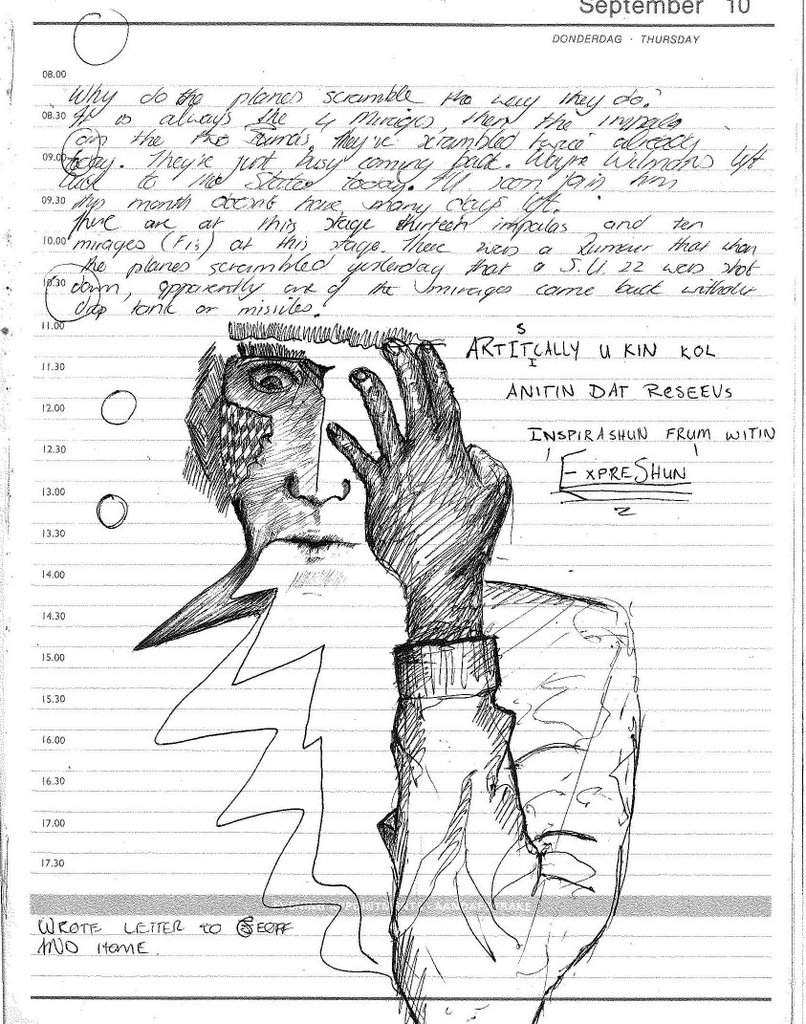
A WAR BY ANY OTHER NAME


(Image Courtesey of Ben Carver: 6SAI – Grahamstown – 1985)

The word “reminisce” just does not see right for me. I dont know what the correct word would be for talking about this war.

What I do know is that, for me, there is an energy in these discussions. At this time, I am able to spend hours writing and talking about the war when I am otherwise exhausted and depleted. There are other things too in my life that attract a similary inner energy, or vibration. I am slowly learning to not be to worried about why these things give me energy when I allocate my time to them, but just to allocate my time to them.

I find I have a preference for reggae music, carpentry, pornographic movies, fishing and road running. All of these I have “energy” for. To be honest I don’t know where these preferences have come from or why they come with “energy”. They are just there, and I just go with them.

What I find perplexing though, is why so little is spoken of this war. We know more about the battle of Isandlwayo, Custer’s Last Stand, the Falklands War, Yon Kippur, 9-11 and “Bloody Sunday”, than we do about the Battle of Cuito Cuanavalle. How can this be?

I remember when I came back from Rundu toward the end of 1987. Coming back home was eary,… surreal. It was as if though to me the “real world” was happening back up there, north of here. This big war, this massive operation, day long convoys, body bags lined up on the tarmac, Migage F1’s shot down, airforce scrambling 3 times a day, red alert, readiness state High!….guys back from frontline with new browns and the “thousand yard stare”

But when I got back home, to my family, nobody new anything of what was happening. I was simply swept away in the curent of petty, sub-urban realities. Straight into first year at Varsity. Classmates straight out of school. Nobody had heard of Rundu, Grootfontein, Oshakati, Cuito, Operation Modular (remember it was just refered to as the “operational area” it was illegal for the media or anyone to be more specific). I did not feel sorry for myself, or did I in any kind of pain, I was relieved not o have had it as bad as those who were in the thick of the fihting, I was elated to be finished with my time and have it all (almost all) behind me. And for these reasons, there was not really much talk about the war at that time (and I suppose ever since).

But also I think, so little is known of the Angolan Bush War for the reasons that Michalel Graaf points out. ….”History is written by the victors”. And in this case neither the National Party or the ANC (the two major powers in SA since the eighties) can claim any stake in the victory. The National Party considered this as a defeat. This is evidenced by the fact that in spite of there massive propoganda machine, they made no attempt to popularise the “history” of the Angolan Bushwar.

What is more suprising though is that as the ANC became dominant, so liitle effort has been made to record and popularise this significant epsiode where conventional forces came head to head in Southern Angola in the late eighties, resulting in a bloody and crushing battle, which lead to a South African withdrawal from Angola, the acceptance of UN resolution 435 and the paving of the way for UNTAG to take control in Namibia. All this, a very significant blow to the forces of Apartheid, ….but no real contribution from MK and the ANC…..

Is it because the ANC cannot claim involvment in this defeat of the Aparthied System that we will pass slowly into the past without being acknowledged by “History”?

The Famous Falklands War


When I was in Buenos Aires in 2003, I visited the Memorial to Argentinian conscripts and professional soldiers who lost their lives in the Falklands war . What interests me about this war, is the general media and public interest generated by the incident. (Or maybe more correctly, the media dis- interest in the Battle of Cuito Cuanavale and the Angolan war.) In many ways the Falklands War was a much smaller (and less strategically significant) story than the Battle of Cuito Cuanavale. 907 Soldiers died in the

Falklands_war

while at least 4000 troops died at the

Battle_of_Cuito_Cuanavale

At the time, the South African Military PR, tried to sell the battle as a success, history has shown however, that, in fact, this battle set in place a sequence of withdrawals and retreats for apartheid forces in Angola, Namibia and perhaps even South Africa!

This disinterest does not trouble me. I just find it curious!

Who built a Crooked House?


Architects are living through fantastic times in this city and South Africa generally. Not only is there an abundance of work, but a heightened awareness of the value that Architects are able to add to the built environment. There is such a lot of “cool” stuff to do, that I am worried that we try to do too much and loose out on the enjoyment of doing one thing well. I believe though that it is better to take action than to worry!

…So I have taken action.

I love beautiful buildings. Big buildings, small buildings. I love being inside them. The light, the sound, the way people use them. The way they sit in the city or landscape. I love the way these buildings are put together.

There is magic in that; and I am starting to reconnect with this magic.. What surprises me is that I have felt that reconnection not in the billion rand, high visibility, world beating projects running through our office, but rather in something a little more modest….

You see,.. my semi- retired father and I are building a wooden cottage in the Outeniqua indigenous forest. It is a very modest cottage built for family needs; rectangular in plan, with a double pitch corrugated iron roof. When I say we are building the house I don’t mean it as a metaphor for designing and drawing plans for, or a metaphor for sitting around watching the contractor’s progress. No; I mean we are physically, digging, measuring, cutting and fitting (and sometimes knocking down)

It has been great on two significant levels. Let me list them:

Firstly:

When physically building you are compelled to focus on one task. You are compelled to be present. Not to think about the next meeting or the previous phone call. How often do we get a chance to be focussed on the present? Especially those of us in management positions can lead a very fragmented and frantic existence. Many of us have powerful and creative minds but have created a reality for ourselves where we spread our input (and out impact) so thin as not to add the value that we could.

Secondly:

Building in the forest has helped me see the potential of my own hands and energy. I can actually build a house. WOW!
The real truth is that Murray and Roberts could probably build it a little neater. (OK,… a lot neater.) But it is not a competition. We are building the house because that is what we need to do to meet our needs and aspirations right now. We are not building the house to try to compete with Murray and Roberts! But what I am talking about here is something more widespread! A phenomenon that spreads across our lives and effectively limits what we believe we are able to do. We are intimidated by the corporate and media dominated world through which we move every day. We slowly begin to believe that we are not good enough to take action.

We cannot sing as well as Mariah Carey, so we will never dare to sing at a family dinner or in the pub.

We cannot tell stories as well as Stephen King, so why even bother trying.

Mom cannot make clothes as neatly as Edgars, so we’ll rather stay at home than be seen dressed in her homemade tracksuits.

We cannot build as well as Murray and Roberts, so lets not let people laugh at our crooked house!

The net result is that we become intimidated into inaction allowing big corporate and media giants to do for us what we used to do for ourselves, and it only takes a little time before we have lost our skills and our dignity forever.

I have in the forest found the joy and freedom of taking back that which I thought I had been robbed of. Cutting planks, laying boards, nailing trusses.

There is magic in that!

Metro FM Music Awards and other small things.

Last night Hlubi and I attended the Metro FM music awards here in PE. It’s a glamorous event that awards such titles as, best Kwaito Album, best singer, best Hip-Hop Group etc. It is a celebrity showcase where everybody who wants to make it in the entertainment industry wants to be seen. The event is young and black and very trendy.

I attended the function this year and last year and was really impressed, confused and amazed by this craze and frenzy for celebrity and anything “famous”. There were of course various live music and dance acts and there was great excitement in the air. Fun really… but as I watched those around me being brought to tears and screams because, Ntando, or Kabelo or “Teargas” just stood up or sat down or sipped their Coca Cola, I could not help to realise how difficult it was for me to be caught up in the general mania. I was enjoying myself, but I did not scream, I did not leap out of my chair waving my arms and shouting “I love you Mzekezeke” … Why not…. I began to wonder? Why do I not get excited? Why do I not get emotional? Is it perhaps something that comes from my army days, when we were trained to continue forward while grenades and live ammunition crack about your head. Not to get exited, not to freak out. Made not to show your pain, but to carry on. Shown how to stare bankly forward carrying the dead on your shoulder. Or perhaps it was more than that, My father conscripted into service in South Africa and Namibia in the early sixties, My father’s father a combatant in World War one, where he survived the battle of Delville Wood, my mother’s father served in North Africa, fighting Rommel in World War two…. Perhaps all of these contributing to a sterness, a militarisation of family culture, a suppression of emotion, a recessiveness. A militarisation that is perhaps not noticed growing up in white middle classes because everyone is very similar. But last night at the Metro FM awards those around me were from homes different to the one that I grew up in and they have no difficulty getting excited in the trivia, the small things of life, ….I suppose the things that make life beautiful!

Cuito or bust!


PW Botha died in his bed in Wildernis last night. He lived to the age of ripe old age of 90 and never stopped wagging his finger at people when talking to them. In his day he was a tough man, I am sure, he was not afraid to take on the world or the armed forces of the ANC, Mozambique and Angola…..which brings me back to Rundu in 1987!

The Angolan border with Namibia was a war zone in the eighties, and (I suppose like any other war zone) information available to combatants is restricted to a “need to know” basis. You do “need to know” that you have to wake up at six in the morning and polish your boots, you don’t “need to know” that the South African Defence Force has just launched a major land and air offensive deep into Angola where they will be thoroughly beaten by Angolan and Cuban forces at the

Battle_of_Cuito_Cuanavale

You don’t “need to know” that for now Angolan and Cuban forces have no plan to chase South Africans all the way back to Rundu and bomb the shit out of your chopper tent!

Anyway, we (some of us) sensed that something was happening by virtue of the fact that huge military convoys (taking a full day to pass by) were crossing over into Angola, the runway was piled with body bags as the Puma helicopters came back over the river to base. Mirage F1’s, Impala’s and Pumas’were “scrambling” two or three times a day and coming back all shot up and buggered. We were on “readiness state high”, sitting on the anti aircraft guns, generators running and ammo bins full. Yet in the middle of all this we are all loaded onto troop careers and brought into base and piled into a hall/hanger where we are told to wait for a “surprise”. We had of course, with time, become suspicious of surprises, like the “surprise” of litres and litres of (normally scarce) fresh milk they dish out to drink before forcing you to “leopardcrawl” kilometres through the dust and till you puke all over you’re your overalls.

So, we are sitting in the hot, sweaty hanger and eventually after a long wait we are presented by the Officer Commanding with the President of the Republic, PW Botha. Then we really new there was big shit going on! He spoke to us of how grateful the nation was for the great sacrifice we were making, and how right would persevere over wrong. I can’t remember exactly what he said, but I remember that, without him giving any details, that we were caught up in the middle of something serious and we were all going to die.

Only after returning back to South Africa and the passing of three months until January 1988, did the news eventually hit the newspapers that there had been a major “operation” in southern Angola (

Operation_Modular

). History will remember operation Modular as the great turning point in the Angolan war. South Africans badly beaten at the battle of Cuito Cuanavale, retreating and eventually causing the government to concede to the provisions of United Nations resolution 435, opening the way for the “UNTAG” international peacekeeping force and Namibia’s first democratic elections that followed.

Anyhow, that was the last time I was in the same room as PW Botha.

Are you on Drugs ek se?!

The response to this blog has been great. Thanks to everyone who is participating. I have seen that people are reading the blog from all parts of the world! So for those of you from Equador, or Egypt or Amsterdam or Austria, who are viewing “Sletroep” but may not be familiar with Afrikaans ( the de facto official language of the South African Defense Force in the 1980’s) the following translation may be useful:

The term “sleg troep” literally means “bad soldier”. Perhaps more rotten than bad because the inference was that one “sleg” soldier could contaminate an entire group. To be “sleg’ was more than just to be lacking in discipline; it was not conforming. It was not being part of the general group mentality that prevailed.

Behaviour that did not conform, or was not understood, would be attributed to that individual being either on drugs or a “voken Kommunis” or a “voken moffie”. By 1987 in the 10 Anti-Aircraft regiment, there didn’t seem to be much debate amoung the permanent force leadership (and their hangers on) that I was definitely a scary combination of all three these evils. The debate seemed more to revolve around which of my friends (by virtue of association with me) should be categorised as drug adicts, communists or gays .

I maybe brought it on myself by not integrating with those around me. I remember in Rundu, I was on a strange mission. For one, I had decided not to spend any money at all. I was there for three months and we would get a special “danger pay” for being on the border. Everyone used this money to go into the base ( about 10km drive though the bush) and buy beer and sweets and stuff. For me not spending was an exercise in discipline and stoicism.

I was studying two subjects through unisa at the time, so I spent a lot of time reading for my studies and reading other books I had brought along. I listened to reggae music and my mono speaker cassette recorder. I kept a journal and drew pictures in a notebook. This must have been very scary to those around me who were generally more interested in screaming at each other, slapping each other, stealing from each other and just generally being stupid.

I refused to eat meals with the rest of the people in the “section”. I should explain….As anti-aircraft artillery, our mission at Rundu was to defend the airbase from airborne assault. To do this a “battery” consisting of four “sections” was deployed in the bush around the runway. (One section at roughly each of the corners of the runway). Each “section” consisted of two 35 mm Oerlicon anti aircraft guns, connected by cable to a Radar. The radar would be at the centre of the section and the guns about 50 m away from it on each side. So the centre of the “section” was around the radar. This I where the section commander (normally a leutenant) had his tent. Each of the guns had a gun commander. I was a gun commander. An each gun commander would have a team of six or seven “gunners”. So to come back to the eating arrangements.. What would happen is that the section would converge for meals in a tent near the radar, metal trestle table were set out. Food would be driven in from the base in shiny steel warming canisters. ( there was a kitchen at the base) Eating this food would be a continuous shouting match, swearing and spiting and shoving. Completely crazy. I could not stand it!

I ate my food alone at my tent by the gun ramp.

The red star of the revolution is on Godwana’s door!


The red star of the revolution is on Godwana’s door. I don’t know who put it there or what they meant by it. But an eager jazz band plays there on the weekends. As I sat watching the crowd on Sunday, dancing, drinking, having fun and mixing freely I realised that this, in a way, was the society that I had dreamed of in the eighties.

Café Godwana is on the beachfront and Sunday evenings see a crowd of students, jazz lovers, black and white, young and old. Not self conscious or contrived but just comfortably enjoying the space and time together.

In Rundu (on the Angolan border in 1987) I knew that there was something wrong. I was intensely aware that we were in an abnormal situation, an abnormal and distorted society. I sensed clearly then that a new society would emerge, completely different and transformed. I remember thoughts like these playing through my mind,… but mostly then I remember being on a personal quest, brought about perhaps that I felt intensely different from those around me.

After arriving on the plane on that hot, bright white air strip, I came to find that we were in Rundu. We were driven on the back of a Samil 100 troop carrier away from the runway into the bush. Here we found our new home in the bush on the edge of the runway. Chopper tents, under camouflage nets around the 35mm Anti aircraft gun and radar system. Our mission… to protect the runway, the northern most airbase of the South African Defence force from Cuban Mig 23s and other Angolan military aircraft.

Intelligence reports had been received of “high level bombing” that would happen on the evening of the next full moon. Our defences were inadequate, so we spent the next week re-digging bunkers in the soft white sand. Repairing camouflage nets and building sandbag walls around our tents, around the guns around the radar. It was back breaking work, in hot weather, in a foreign country, in a war zone. But in this intense discomfort I came to one of the most significant realisations of my life. A truth that has come with me to this day. Walking up a steep “gun ramp” embankment with a sandbag on my back in the blazing sun; dirty with sand in my teeth, my ears, my hair…. I simply chose at that time not to be angry , frustrated or despondent. I chose at that moment and in that space to be happy. I knew on that day that I had stumbled on a great truth; the truth that happiness is a choice we make for ourselves, that happiness does not come out of circumstance, that happiness is not a product what we do or how we are treated, that happiness is a state of mind that we choose to claim for ourselves.

When the full moon evening came at the end of the week, the night was cool and clear. The “high level” bombers never came. We were not bombed… This too caused me great happiness!